
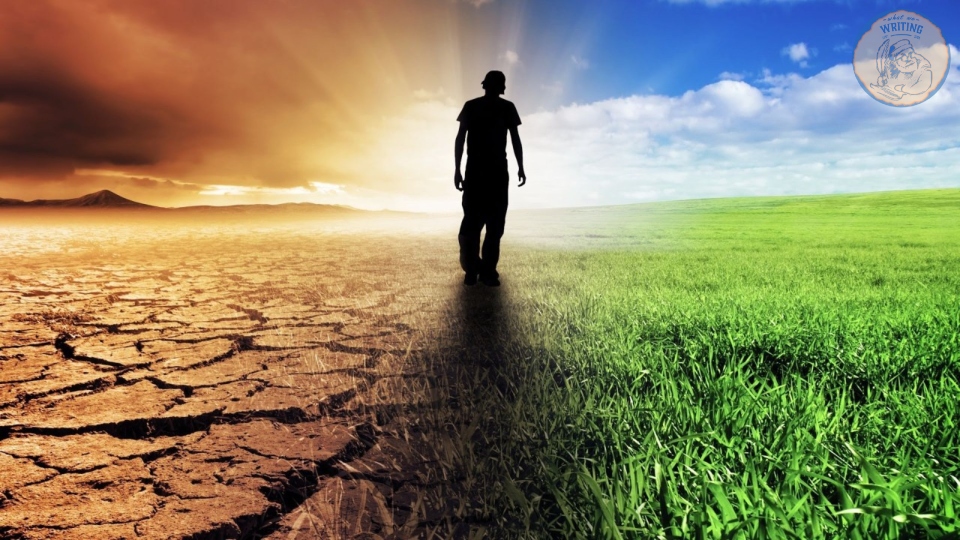
A chill breeze rushes through the trees. Snow cascades harder, faster, until the road vanishes entirely. There’s no signal, no shelter – just the gnawing realisation that survival is contingent on outlasting the elements. Moments like this are the beating heart of one of the most powerful conflicts: person vs nature.
Stripped completely back, person vs nature conflict is precisely what it sounds like – a character squaring up against the natural world. This might mean battling extreme weather, surviving in the wilderness, or grappling with forces such as disease or disaster. Unlike other conflicts, there isn’t a major villain with any intent – nature is indifferent, and that is exactly why it can be so terrifying.
This type of conflict has endured for a reason. It hauls characters back to their most vulnerable, ratcheting up the stakes immediately and forcing raw, human choices.
Today at What We Writing, we’ll break down what person vs nature really means, explore some of the best examples in literature, and look at why it remains so compelling to both read and write.
What Is Person vs Nature?
Put simply, person vs nature is a type of conflict where a character is pitted against the natural world. Rather than facing off against another person or societal force, the struggle stems from elements outside of human control – things such as weather, landscapes, or biological forces.
“Nature” in this context is broad. It can mean extreme weather, such as violent storms, freezing temperatures, or relentless heat. It can also involve the wilderness itself – being stranded in a forest, shipwrecked at sea, or cut off from civilisation, scenarios where survival becomes the principal challenge.
In other stories, nature takes the form of huge, epic-scaled disasters like floods, wildfires, or hurricanes, where characters need to react decisively in order to stay alive.
Even illnesses and pandemics can fall under this category of storytelling, as they represent natural forces acting on the human body.
What makes person vs nature so distinctive is that there isn’t a recognisable antagonist. Nature isn’t cruel nor is it kind – it simply exists, uncaring about human survival. This creates a different sort of tension, where the conflict is less about defeating an enemy and more about endurance, resilience, and the will to survive.

Key Characteristics Of Person Vs Nature Conflict
Person vs nature conflicts share a few core traits that make them immediately immersive and emotionally intense:
- Survival at the core
In most cases, the character’s central goal is pure and simple: survive. Whether they’re battling the cold, hunger, or exhaustion, each decision carries life-or-death consequences. - Characters are pushed to their limits
These stories test both physical endurance and emotional resilience. Characters are confronted with terrifying scenarios, desperation, and self-doubt. - Nature is indifferent, not evil
Unlike a human antagonist, nature has no motive or intent. A storm doesn’t “target” anyone – it just exists. That lack of a true intention can make the conflict feel even scarier. - Isolation plays a major role
A lot of person vs nature stories involve characters being cut off from help – lost in the wilderness, stranded somewhere, or totally alone. This heightens that sense of vulnerability. - The stakes are instantly high
This is rarely a slow build. Danger is found from the get-go, creating immediate tension and urgency that drives the story forward.
Why Person Vs Nature Is So Powerful In Stories
Person vs nature is such a powerful type of conflict because it taps into something universal. Everyone, at some level, understands the force of nature – whether it’s the fear of a storm on the horizon, the unknowns of the sea, or the vulnerability of being isolated in an unfamiliar environment. That shared understanding makes the stakes feel immediate and real.
It also strips down the characters to their core. Without the safety nets of other people or wider society, what’s left is pure instinct, decision-making, and raw emotion. These stories often showcase who a character really is under pressure – what they’re prepared to do, what they can endure, and where their limits are.
There’s also an inherent tension woven into this type of conflict. Survival is normally on the line, which means the stakes are clear from the outset. Readers don’t need much of a setup to feel invested.
At the same time, person vs nature couples up wonderfully with internal conflict stories. As characters battle the external world, they’re also forced to wrestle with fear, doubt, guilt, or determination all within themselves, providing an extra layer of depth.
Check Out Our Guide To Character Vs Self Conflict
Famous Examples Of Person Vs Nature In Literature
Here are some of the best examples of person vs nature conflict in literature, spanning both classic and contemporary works:
- To Build a Fire
A man ventures into the Yukon wilderness in extreme cold, underestimating the brutal conditions until it is too late.
The story is a stark example of person vs nature, demonstrating how human arrogance collapses in the face of an unforgiving environment. - The Old Man and the Sea
An ageing fisherman wrestles the ocean and a giant marlin in a dogged test of endurance.
The conflict stems from his struggle against the sea itself – its power, unpredictability, and the physical toll it saps. - Life of Pi
After a shipwreck, Pi survives on a lifeboat in the Pacific Ocean alongside a Bengal tiger. The novel explores survival against the elements, with the ocean and the natural world both constantly threatening his life. - Into the Wild
This nonfiction account follows Christopher McCandless as he ventures into the Alaskan wilderness, seeking isolation.
It’s a real-life demonstration of person vs nature, showing both the alluring and dangerous realities of life beyond civilisation. - The Martian
Astronaut Mark Warney is stranded alone on Mars and must use science and ingenuity to survive. Here, nature takes the form of an alien environment, where a lack of air, water, and resources creates constant life-threatening dangers.
Person Vs Nature Vs Other Types Of Conflict
Understanding person vs nature becomes even clearer when you compare it to some of the other common types of conflict in storytelling. Whilst all conflicts create tension, the source of that tension – and how characters respond to it – can all look very different.
Here’s a simple breakdown for you to reference:
| Type of Conflict | What It Means | Where The Conflict Comes From |
| Person vs Nature | A character wrestles with natural forces | External and uncontrollable (weather, environment, illness) |
| Person vs Self | A character grapples with their own mind and emotions | Internal (emotions, guillt, identity) |
| Person vs Person | A character faces opposition from another individual | External (rivalries, enemies, relationships) |
| Person vs Society | A character challenges social norms or systems | External (laws, culture, expectations) |
What sets person vs nature apart is its defined lack of intent. In a person vs person conflict, there’s a clear antagonist making decisions. In person vs society, the character pushes against structured systems. However, with nature, there’s no room for negotiation or common ground – just forces that exist beyond our control.
That’s why this type of conflict often feels so timely and intense. Whilst other conflicts can be complex or gradual, person vs nature typically launches characters right into high-octane scenarios where survival, instinct, and resilience are given the spotlight.
How To Write Person Vs Nature Conflict
Writing a compelling person vs nature conflict is all about making the environment feel as vivid and impactful as any character – without turning it into your archetypal “villain.” The aim here is to immerse the reader in the experience so that they can feel every moment of the struggle.
- Make nature feel real and ever-present
Treat the environment as a constant force in the story. Whether it’s the biting cold, unrelenting heat, or aggressive waves, nature should influence every choice your character makes. - Raise the stakes gradually
Start with manageable challenges, then escalate them. A light snowfall can turn into a blizzard; a minor injury might become infected. This buildup builds tension naturally and keeps your audience hooked. - Use sensory details to ground your story
Focus on what your character sees, hears, and feels. The sting of icy wind, the silence of an empty landscape, or the suffocating heat of the sun can all make the conflict feel authentic and pressing. - Show the emotional and mental toll
Survival isn’t just physical. Allow readers to see the fear, frustration, doubt, and determination your character experiences. This adds depth and often brings in elements of person vs self conflict. - Avoid turning nature into a “villain”
Nature isn’t out to get your characters – it’s totally indifferent. Keeping that neutrality makes the story far more natural and oftentimes more unsettling, because there’s no reasoning with the forces at work.
When it’s done well, person vs nature conflicts haul readers into a raw, immersive experience where each moment feels uncertain and hard-won.
Check Out The Best Examples Of Person Vs Nature Books On Our Sister Site, What We Reading
Wrap Up
At its core, person vs nature is a conflict where a character is forced to battle the natural world, grappling with forces that are powerful, unpredictable, and totally beyond human control.
What makes it so compelling is its simplicity and intensity – there are no negotiations, no clear villains, just the raw struggle to survive. These stories tap into something deeply human, pushing characters to their limits while revealing who they truly are when the pressure strikes.
Whether set in an icy wilderness, never-ending oceanscapes, or even outer space, person vs nature remains one of the most gripping and timeless forms of conflict in storytelling.
Looking for more literary conflict types? Explore our range of guides and examples to deepen your understanding of how stories create tension and keep us readers gripped.
Get Out Our Guide To Writing The Central Conflict In A Story

James has been passionate about storytelling ever since he could hold a pen. Inspired by the epic fantasy and historical dramas he devoured in his youth, his work now centers on dark, psychological tales featuring intense, introspective characters and atmospheric, gothic undertones. In 2025, he founded What We Writing to share his creative journey and the lessons he’s learned along the way with fellow writers and passionate storytellers.

