
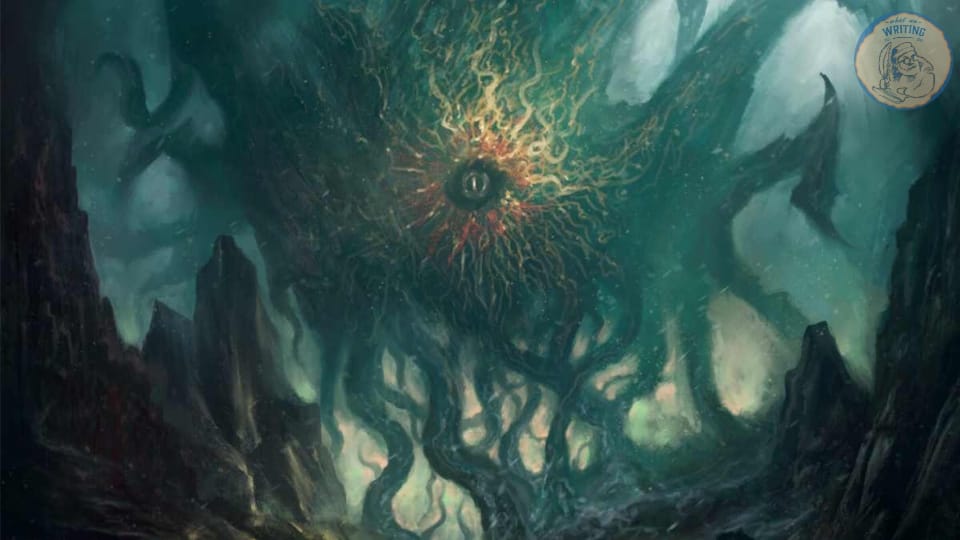
Cosmic horror isn’t just about monsters springing out from the dark – it’s about the quiet, creeping realisation that humanity is small, powerless, and totally insignificant in the vast, unknowable universe. Founded by writers like H.P. Lovecraft, this genre is all about dread, ambiguity, and the fear that comes from forces far beyond human comprehension. Rather than getting clear answers or neat resolutions, cosmic horror leaves both characters and the audience unsettled, questioning reality itself.
Today at What We Writing, we’re guiding you through precisely how to write cosmic horror that captures its iconic, unsettling atmosphere. We’ll break down the key elements that define the genre, explore some of the most powerful examples, and walk through a step-by-step process you can use in your own stories. You’ll also find our favourite practical tips, common pitfalls to avoid, and a collection of story ideas to get you going.
What Is Cosmic Horror (With Clear Examples)
Cosmic horror is a subgenre in the horror world that’s built around a simple yet unsettling concept: the universe is vast, indifferent, and far beyond human understanding. Rather than focusing on ghosts, killers, or monsters you can fight, cosmic horror thrives on the fear of the unknowable – forces so alien and immense that they make human life feel small and meaningless.
When we think about this genre of stories, we often think of H.P. Lovecraft, whose stories introduced readers to ancient, god-like entities and forbidden knowledge that leads people to madness.
However, cosmic horror isn’t all about tentacled creatures or dark cultish rituals. At its heart, it’s about confronting the limits of human perception, and discovering that some truths are too vast – or too terrifying – to completely comprehend.
This is most obvious in stories where characters discover something they were never meant to understand, whether that be an ancient presence lurking beneath reality, or a subtle shift in the laws of nature itself. The horror doesn’t come from what is shown, but instead from what can’t be explained.

Key Characteristics of Cosmic Horror
The most important characteristics of cosmic horror include:
Insignificance of Humanity
Characters are usually confronted by the idea that humans do not matter at all in the grand scheme of the universe, which conjures a deep sense of existential dread.
Unknowable Entities
The focus at the core of cosmic horror is rarely fully seen or understood. Their true nature is beyond human comprehension, making them far more terrifying than a run-of-the-mill monster.
Forbidden Knowledge
Characters frequently discover truths that were meant to remain hidden. This knowledge doesn’t empower them – it destabilises them, often leading to fear, obsession, or madness.
Psychological Dread over Physical Horror
Instead of relying on gore or violence, cosmic horror establishes tension through atmosphere, uncertainty, and the slow erosion of a character’s sense of reality.
Famous Cosmic Horror Examples (Books & Media)
It’s so much easier to understand cosmic horror once you’ve seen how it looks in practice. These iconic examples of cosmic horror don’t just define the genre – they show how to create that lingering feeling of unease that makes this world so powerful.
The Call of Cthulhu – Unknowable Entities
This classic story by H.P. Lovecraft centres on an ancient, god-like being whose existence dwarfs human understanding. What makes it one of the best influential cosmic horror stories isn’t just the creature, but how little we ever fully grasp it.
The narrative is fragmented, built from reports and second-hand accounts, reinforcing the concept that the truth is simply too vast to comprehend.
What writers can learn: Resist the urge to fully explain your horror. The less clearly the entity is understood, the more unsettling it becomes.
Annihilation – Reality Distortion
In this beloved film, the horror comes from a mysterious zone where the laws of nature start to break down. Familiar things – plants, animals, even human bodies – are subtly altered in ways that feel wrong, but not instantly threatening.
This distortion creates a constant sense of unease, as characters (and the audience) realise that even reality cannot be trusted.
What writers can learn: Cosmic horror doesn’t need a single monster. Warping the rules of reality can be just as effective, particularly when the changes are gradual and hard to explain.
The Lighthouse – Descent into Madness
This story orbits less around external threats and more around psychological collapse. Is there something supernatural at work, or are the characters losing their grip on reality? That ambiguity is crucial. The movie never gives us a clear answer, leaving the audience trapped in the same uncertainty as the characters.
What writers can learn: Cosmic horror thrives on ambiguity. You don’t need to confirm what’s real – oftentimes, it’s more effective to leave both the characters and your readers in the dark.
Together, these examples all highlight a crucial truth: cosmic horror isn’t about what you show, but what you withhold.
5 Core Elements Of Cosmic Horror Stories
If you’re looking to write the best cosmic horror stories, it helps to think of it as a framework rather than a loose set of concepts. The genre is at its best when a few key elements blend together to create that delicious sense of existential dread.
1. The Unknown Needs to Stay Unknown
Cosmic horror loses its power the moment everything is explained. Whether it’s an entity, a force, or a shift in reality, the true nature of the horror should remain just out of reach. Writers such as H.P. Lovecraft understood that suggestion is far more unsettling than clarity.
Focus on: Fragments, unreliable accounts, and unanswered questions.
2. Scale Beyond Human Understanding
The horror needs to feel epic – far bigger than any one character or even humanity itself. This might be an ancient being older than the universe itself, or a phenomenon that spans galaxies. The key here is perspective: your characters are small, and they know it.
Focus on: Overwhelming size, age, or complexity.
3. Fragile Sanity
In cosmic horror, the human mind isn’t equipped to handle the truth. Characters who skirt too close to understanding what’s really happening often wind up going insane. This descent doesn’t need to be dramatic – it can be subtle, quiet, and deeply disturbing.
Focus on: Obsession, paranoia, and creeping doubt.
4. Indifference of the Universe
Compared to traditional horror, there aren’t any villains with obvious motives in cosmic horror. The universe in these types of stories isn’t evil – it’s indifferent. Whatever force exists doesn’t care about humanity whatsoever, which makes it all the more terrifying.
Focus on: Lack of intent, emotionless forces, and inevitability.
5. Slow-Build Dread
Cosmic horror hardly ever calls for sudden shocks. Rather, it builds tension gradually, allowing the unease to deepen over time. Small, strange details accumulate until the total weight of the situation becomes impossible to ignore.
Focus on: Pacing, atmosphere, and escalation.
Together, these elements create stories that linger – not just because of what happens, but because of what it means.
How To Write Cosmic Horror (Step-By-Step)
Cosmic horror is at its best when it’s carefully constructed. It isn’t just about strange ideas – it’s about how you reveal them, control information, and build a lingering feeling of unease. Follow these steps to create a story that feels genuinely unsettling.
Step 1: Start with a Disturbing Idea
Every cosmic horror story starts out with a concept that quietly undermines reality. This isn’t just a scary scenario – it’s a question that destabilises everything your characters (and audience) believe to be true.
“What if reality isn’t real?” is a classic example; however, you can push it even further:
- What if time isn’t moving forward?
- What if something vast is watching, but we’re unable to perceive it?
- What if human consciousness isn’t totally human?
The key here is to choose an idea that doesn’t contain a comfortable explanation. It needs to feel bigger than your story, as though you’re only revealing a small slice of something far grander. Once you’ve got that idea, everything else can grow from it.
Step 2: Create a Limited POV Character
Cosmic horror thrives on restriction. If your character understands too much, the tension evaporates. That’s why a limited point of view – first person or close third – is so effective.
Your protagonist should experience events in real time, with no clear sense of what’s actually happening. They may misinterpret clues, dismiss important information, or slowly piece things together in the wrong way. This keeps the audience trapped in the same uncertainty.
You can strengthen this by giving your character a solid reason to doubt themselves:
- They’re alone
- They’re stressed
- They already feel slightly disconnected from reality
The less reliable their perspective, the more unsettling the story becomes.
Step 3: Reveal, Don’t Explain
One of the biggest mistakes in horror writing is over-explaining. In cosmic horror, explanation is the enemy of fear.
Rather than telling your audience what’s happening, show fragments:
- A document with missing pages
- A pattern that almost makes sense
- A glimpse of something that can’t be fully seen
This is something that authors like H.P. Lovecraft used often – stories built from incomplete accounts, leaving gaps that the reader is left to fill in.
When you do unveil some information, make it raise more questions than it answers. The end goal isn’t clarity – it’s unease.
Step 4: Escalate the Unease
Cosmic horror should build gradually. Begin with something slightly off – something that could almost be explained – and then push it further until it becomes totally impossible to ignore.
For example:
- A strange noise → a repeating pattern → something responding
- A coincidence → a series of coincidences → a deliberate force
Every small step needs to feel like a small shift away from normality. The aim here is escalation without sudden jumps. If things become too hectic too quickly, the audience loses that creeping sense of dread.
By the time the full scope of the horror is hinted at, it should feel overwhelming – not because it appeared suddenly, but because it’s been quietly growing all along.
Step 5: End with Unease, not Resolution
Cosmic horror stories hardly ever end with clear answers. In reality, a neat resolution is far more likely to weaken your whole story.
Instead, aim for an ending that leaves something unresolved:
- The character escapes, but doesn’t understand what happened
- The truth is revealed, but only raises bigger questions
- The horror is still out there – unchanged and indifferent
The goal here is to leave your readers thinking about the story long after it ends. That lingering uncertainty is what makes cosmic horror so powerful.
A strong ending doesn’t close the door – it leaves it ever so slightly ajar.
Common Mistakes To Avoid
Even the strongest concepts can fall flat if you approach cosmic horror the wrong way. The genre depends on restraint, ambiguity, and atmosphere – so these common mistakes can soon undermine the effect you’re gunning to create.
Over-Explaining the Horror
One of the easiest ways to kill the tension in a story is to explain everything too clearly. If the reader totally understands what’s happening, the fear evaporates. Cosmic horror is all about uncertainty, so it’s far more effective to suggest, hint, and leave some gaps.
Let your readers sit with the unanswered questions you toss up rather than tying everything together neatly for them.
Making Monsters too Concrete
It’s tempting to fully describe your creature or entity; however, doing so usually makes it feel smaller and less threatening. Once something can be clearly visualised, it becomes manageable.
In cosmic horror, the most unsettling forces are those that resist definition – things only glimpsed partially, or described in unconventional ways that don’t make total sense.
Relying on Gore Instead of Dread
Graphic violence may shock the audience for a moment, but it doesn’t create the lingering unease that defines cosmic horror.
This genre is far more psychological. It’s about atmosphere, implication, and the slow realisation that something is profoundly wrong. Focus on building tension rather than diving straight for an immediate impact.
Copying H.P. Lovecraft too Closely
Lovecraft moulded the genre, but copying his style, language, or specific ideas too directly can make your work feel derivative.
Rather than repeating familiar tropes, home in on what makes his stories so influential – the sense of scale, the unknown, the fragility of the human mind – and apply those principles in a way that is uniquely your own.
Avoiding these pitfalls will ensure your story feels more original, more unsettling, and far more memorable.
Cosmic Horror Story Ideas (Immediate Inspiration)
If you’re struggling to come up with a concept, cosmic horror is a great genre to experiment with unsettling “what if” scenarios. The secret is to start with something familiar, then introduce a shift that makes reality feel unstable or unknowable.
- A signal from space that rewrites memories
Astronomers detect a repeating transmission, but anyone who listens to it immediately starts recalling a life that they never lived. As the signal spreads, reality itself begins to feel inconsistent. - A town where time loops – but slightly wrong each time
Each day repeats, yet small details change: people disappear, buildings move, and conversations don’t quite match up. Eventually, the pattern suggests that something is learning. - A character discovers they aren’t human
Through strange physical changes and fragmented memories, someone begins to suspect they were never human at all – just something placed here, waiting to become aware. - A deep-sea expedition that finds something looking back
Explorers discover a vast structure beneath the ocean, but it doesn’t appear to be abandoned. The deeper they go, the more it feels like they’ve entered something alive. - A language that alters reality when spoken
An ancient text is translated, revealing words that reshape the world. At first, the changes are small – but they soon begin to spiral out of control. - The stars are disappearing – but only one person notices
As constellations vanish from the sky, everyone else insists that nothing has changed. The more the protagonist investigates, the more isolated they become.
Check Out These Horror Writing Prompts Inspired By Unsettling Places
Each of these ideas works because it introduces a concept that can’t be easily explained – lending you the room needed to build tension, ambiguity, and dread.
Wrap Up
At its heart, cosmic horror isn’t about monsters or violence – it’s about the fear of what can’t be explained or understood. It asks a simple yet deeply unsettling question: what if reality is far larger, stranger, and more indifferent than we are capable of comprehending? That feeling of insignificance, of standing at the edge of something vast and unknowable, is what provides this genre with its power.
Writing cosmic horror means learning to lean into uncertainty rather than trying to resolve it. The more you resist explaining everything, the more space you create for tension, atmosphere, and lingering unease.
Whether you’re building around distorted reality, forbidden knowledge, or forces that exist beyond human perception, the aim is always the same: to leave the reader questioning what is real.
If you’re ready to try it yourself, start small. Take one unsettling idea, limit what your characters can understand, and the unknown does the rest of the legwork. And if you’re looking for inspiration, you can explore some of the best cosmic horror stories and novels that show the genre at its shining best.

James has been passionate about storytelling ever since he could hold a pen. Inspired by the epic fantasy and historical dramas he devoured in his youth, his work now centers on dark, psychological tales featuring intense, introspective characters and atmospheric, gothic undertones. In 2025, he founded What We Writing to share his creative journey and the lessons he’s learned along the way with fellow writers and passionate storytellers.

