
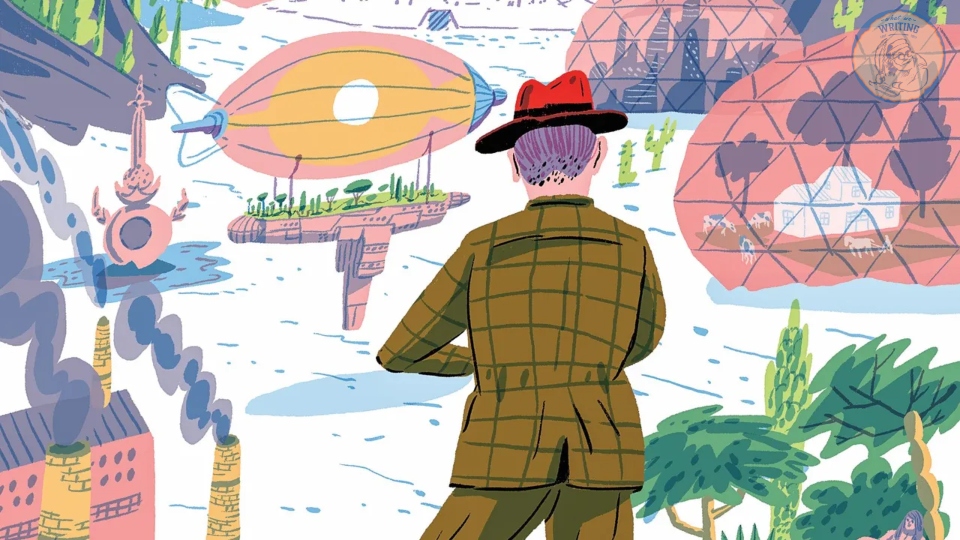
If you’re like us and are a sucker for bleak worlds where the future has gone off the rails, you’re probably more than familiar with the dystopian genre in fiction. Thankfully, if the likes of The Handmaid’s Tale and The Road aren’t your thing, dystopian fiction has a far less bleak sibling in the realms of speculative fiction, sci-fi, and fantasy; this sibling genre is referred to as utopian fiction. Similar to dystopian stories, utopian fiction has existed for centuries, spanning an entire arsenal of cultures and philosophies. Join us here at What We Writing as we run you through the definition of utopian fiction, its history within literature, the many forms it can come in, and some of the must-read works you need on your TBR pile to fully appreciate this fascinating, if slightly overlooked, genre of writing.
What Is Utopian Literature?
Utopian fiction is a style of fiction that takes place in an idealised world. The writer of a utopian novel sets the narrative in a world that matches their own ethos and personal philosophy for what a ‘better’ world would look like. These stories explore what an ideal society might look like, often highlighting harmony, equality, sustainability, or new systems for co-existing.
However, this doesn’t mean that utopian novels are exempt from any conflict. Whilst these scenarios may appear to be a “perfect world” on the surface, they’re rarely so under the surface. Most of their imagined societies come with deeper moral, political, or philosophical questions: What does a good life look like? Who can define perfection? What might we need to sacrifice to achieve a better world?
These big questions are what attach utopian literature to the likes of speculative fiction, sci-fi, and philosophy. Many utopian stories imagine futuristic technologies or social structures; others might reimagine the present through alternative systems of governance, community, or resource-sharing.
At their heart, all works of utopian fiction dare us to imagine a world that could be – and ask whether we really would consider swapping our own for it.

Origins Of Utopian Fiction
The term “utopia” was first coined by English philosopher Sir Thomas More, recalling the ancient Greek word meaning “good place” and “no place.” More’s book, Utopia, first published in 1516, outlined an ideal utopian society, and his vision has gone on to serve as a touchstone for philosophers, public servants, and fiction writers alike. To this day, utopian studies are offered in philosophical departments in most major universities.
Whilst it was More who first used the term “utopia,” the examination of perfect societies predates him by a good few centuries. Around 370 BCE, Plato published his Republic, which outlined his attributes of an ideal state. Plato’s Republic inspired philosophers of other nationalities, such as the Roman Plutarch, to envision a best-case scenario future civilisation.
Post-More, utopian fiction gained prominence in works such as New Atlantis (1627) by Sir Francis Bacon. Elsewhere, The City of the Sun (1623) by Tommaso Campanella further expanded More’s utopian philosophy.
Why Writers Create Utopias
Writers don’t build utopias just to see what a flawless setting might look like. In utopian literature, these “perfect world” societies become powerful tools for tackling real issues, testing ideas, and challenging the audience’s assumptions. Here are some of the main reasons why authors conjure utopian stories:
Social Critique
Many utopian novels take aim at something specific that’s broken in our world by showing a society where those issues don’t exist. By imagining an ideal community – whether it’s free from inequality, conflict, or environmental collapse – writers shine the spotlight on the flaws, injustices, or limitations of the present.
The utopian world becomes a mirror, reflecting back the issues we ignore.
Philosophical Exploration
Utopian fiction often grapples with big, timeless, unanswerable questions:
What makes a good life? Should the needs of the many really outweigh those of the few? Is freedom more important than stability?
By building a whole society from the ground up, authors can explore ethics, human nature, happiness, and the meaning of progress in a tangible, narrative-driven manner.
Political Ideas
Utopian books test political visions of all makes and models. From democratic utopians to communal, feminist, ecological, or even technologically advanced societies, writers of utopian fiction imagine how different systems may function if they were fully realised. This gives readers the tantalising opportunity of seeing how these political theories play out in some sort of reality.
Hope vs. Warning
Not every utopia is hopeful. Some are aspirational, providing the audience with a vision worth working toward. Others are more ambivalent, demonstrating how even the “perfect” systems can have blind spots, hidden costs, or unintended consequences.
These works all blur the lines between utopian and dystopian fiction, highlighting how even the quest for perfection can itself be dangerous.
Literary Experimentation
Utopia has always been a playground for writers who want to push some boundaries. Because utopian literature isn’t tied to real-world constraints, it encourages bold worldbuilding, unconventional storytelling structures, travelogues, imagined documents, and hybrid forms that blend fiction with philosophy and social theory.
Key Characteristics Of Utopian Fiction
As we mentioned above, utopian literature usually isolates elements of the present-day world that need improving, and it conjures a world that features that improvement. These features help a reader recognise the genre and understand how authors build their versions of a “perfect world.”
A Carefully Structured Society
Utopian literature typically orbits around a society designed with intention – nothing is left to chance. Systems of governance, education, labour, justice, and community life are all purposefully organised to remove conflict, inequality, or inefficiency. These structures show the author’s vision of what a truly optimised society may look like.
Harmony and Equality
A core characteristic of utopian fiction is the pursuit of balance and fairness. Whether it’s gender equality, social harmony, environmental stability, or the absence of poverty, these books usually draw a world where major societal problems have been put to bed. This harmony is what makes the society “ideal,” at least on the surface.
Advanced Technology or Innovative Social Organisation
Many utopian novels use futuristic technologies to support their ideal worlds – cleaner energies, medical breakthroughs, automated labour, or advanced infrastructure. Others put less emphasis on the technology and more on the novel systems of living: communal ownership, decentralised governance, or alternative economic models.
Both of these approaches show how societies may grow beyond our current limitations.
Philosophical or Political Underpinnings
Every utopia is built on a set of beliefs. These could be socialist, ecological, feminist, libertarian, spiritual, or humanistic. The story becomes a means through which those concepts can be put to the test. The society’s rules, norms, and institutions reflect the philosophical or political theories the author wants to tackle.
Emphasis on the Collective Rather Than the Individual
Unlike many contemporary novels, which are grounded in personal struggles, utopian literature typically highlights the well-being of the community. The protagonist might still have conflicts; however, the story usually emphasises societal cooperation, shared values, and the greater good. This collective focus is a hallmark of the genre.
Told Through Travelogues, Diaries, or Outsider POVs
One of the classic characteristics of utopian literature is its narrative framing. Many stories introduce the utopian world through:
- A traveller happens upon a new society,
- A diary or historical document,
- Or an outsider recounting their observations.
These structures allow the narrator – and the audience – to compare the utopia with their own world, highlighting the contrasts and raising deeper questions.
6 Types Of Utopian Literature
Utopian fiction comes in all sorts of different shapes and sizes, each one imagining a different vision of what a “perfect world” may look like. These subgenres reveal the diverse hopes, values, and critiques that authors bring to their imagined societies. Exploring the various types of utopian literature helps readers understand how flexible – and culturally revealing – the genre can be.
1. Ecological Utopias
Ecological utopias picture societies that live in total harmony with the natural world. These stories emphasise sustainability, environmental balance, and a deep respect for ecosystems. Often responding to real-world climate crises and anxieties, ecological utopias explore renewable energy, communal agriculture, resource-sharing, and lifestyles designed to preserve the planet for future generations.
They ask: What if a perfect society wasn’t defined by technology, but by reconnecting with the earth?
2. Feminist Utopias
Feminist utopias explore gender-equal or even women-led societies that challenge established patriarchal norms. Writers from the late twentieth century – namely the likes of Ursula K. Le Guin, Marge Piercy, and Charlotte Perkins Gilman – use these fictional worlds to explore themes of equality, autonomy, sexuality, and community. These works reimagine social structures around cooperation rather than dominance, presenting alternative ideas around power, identity, and belonging.
3. Technological Utopias
In technological utopias, innovation is the key to creating a better world. These societies depend upon science, automation, medicine, or infrastructure to eliminate hardships and improve the quality of life. While some portray technology as liberating and transformative, others question whether reliance on machines can really lead to us humans flourishing.
This subtype in particular overlaps strongly with futuristic and more sci-fi narratives.
4. Literary / Artistic Utopias
Some utopian fiction imagines worlds where creativity is rooted in the centre of life. These artistic or literary utopias craft societies that prioritise expression, storytelling, music, and cultural creation above material concerns. They explore the role of art in moulding an identity and community, indicating that a truly ideal society may just be the one where imagination itself is the organising principle.
5. Religious / Spiritual Utopias
Religious or spiritual utopias depict ideal societies grounded in faith, moral principles, or divine guidance. These worlds emphasise virtue, purity, or universal harmony, mirroring the writer’s belief in the transformative power of spirituality. Whether it’s grounded in Judeo-Christian symbolism, Eastern philosophies, or entirely fictional belief models, these utopias explore how moral frameworks guide human behaviours.
6. Socialist / Communal Utopias
Socialist or communal utopias imagine societies built on equality, shared resources, and collective ownership. There’s little to no class hierarchy; wealth and labour are shared equally; cooperation replaces competition.
These stories often draw inspiration from real political movements and theories, using fiction to explore communal living, solidarity, and the possibility of a society without economic exploitation.
Utopian Vs. Dystopian Literature: What Are The Differences?
Utopian fiction is set in a perfect world – an improved version of reality. On the flip side, dystopian fiction does the polar opposite. A dystopian novel drops its main character into a world where everything appears to have gone wrong at a macro level.
Similar to utopian novels, dystopian stories can take place in the far future, the past, or an alternate present. Some might feature altered versions of real-world places; others may be fully set in fictional environments. Here are some of our favourite dystopian books from across history:
- Brave New World by Aldous Huxley
- The Road by Cormac McCarthy
- 1984 by George Orwell
- The Handmaid’s Tale by Margaret Atwood
- The Hunger Games by Suzanne Collins
Both utopianism and dystopianism blur the boundaries between fiction, philosophy, and political science. For example, a lot of George Orwell’s works are steeped in all three of the above. Whether describing a modern utopia, an imagined lost golden age, or a future ecological utopia set on a verdant space station, utopian stories have endured for centuries.
And, unlike their dystopian counterparts, they provide a reminder of the positive potential of humankind.
10 Of The Most Influential Utopian Books Every Reader Should Know
Utopian literature spans centuries, evolving alongside society’s hopes, anxieties, and political movements. From early imaginings of ideal governance to modern explorations of sustainability and equality, these works have all shaped how readers imagine a better world. Here is a curated list of the most influential and top utopian novels – from foundational classics to contemporary interpretations.
1. Utopia by Thomas More (1516)
The book that lends the genre its name. More outlines an island society built on equality, rationality, shared labour, and communal ownership. Though partly satirical, Utopia lays the groundwork for imagining ideal societies as a lens for critiquing the present.
2. Looking Backward by Edward Bellamy (1888)
Bellamy’s protagonist awakes in the year 2000 to find a peaceful, cooperative, classless America. The novel’s vision of economic equality and social harmony made it a literary sensation, inspiring real-world political movements and utopian clubs.
3. News from Nowhere by William Morris (1890)
Written partly in response to Bellamy, Morris imagines a pastoral, craft-focused society firmly grounded in communal living and artistic fulfilment. His utopia rejects industrial capitalism in favour of simplicity, beauty, and mutual aid.
4. Walden Two by B.F. Skinner (1948)
This behavioural utopia proposes a community organised through psychological principles rather than punishment or reward. Skinner explores how behavioural science may create a happier, more cooperative society – presenting fascinating ethical questions along the way.
5. Island by Aldous Huxley (1962)
Often contrasted as the optimistic twin of his iconic Brave New World, Huxley’s final novel imagines Pala, a peaceful island that blends Eastern spirituality, scientific understanding, and compassionate living. It’s a philosophical and deeply human vision of a possible paradise.
6. Woman on the Edge of Time by Marge Piercy (1976)
A cornerstone of feminist utopian fiction, Piercy’s work presents a gender-equal future community constructed around cooperation, sustainability, and freedom. It contrasts sharply with a dystopian alternative, making the utopian vision feel both hopeful and fragile.
7. The Dispossessed by Ursula K. Le Guin (1974)
Le Guin’s “ambiguous utopia” explores a society formed on anarchic principles: decentralised governance, mutual aid, and a rejection of materialism. Its nuanced depiction highlights both the strengths and strains of a world built solely around collective norms.
8. Always Coming Home by Ursula K. Le Guin (1985)
More anthropological than narrative, this story centres around the Kesh, a future people living in balance with the nature of Northern California. Its blend of fiction, mythology, poetry, and ethnography imagines a sustainable, culturally rich society.
9. Ectopia by Ernest Callenbach (1975)
One of the most defining works of ecological utopia, Ecotopia imagines a breakaway nation devoted solely to renewable energy, green living, and environmental stewardship. Its focus on sustainability has influenced environmental movements for decades.
10. The Giver by Lois Lowry (1993)
Often read as dystopia today, The Giver opens with the appearance of a perfect, orderly society: no war, no pain, no inequality. As the protagonist uncovers the community’s hidden costs, the novel becomes a powerful exploration of what happens when a “perfect world” is built on suppression.
Modern Utopian (and Utopia-Adjacent) Works Worth Reading
Sprinkling in some more modern titles helps take your understanding of how our visions for ideal societies have continued to evolve. Here are some of our favourites:
The Fifth Sacred Thing by Starhawk (1993)
A visionary ecological utopia depicting a spiritual and sustainable future, California is resisting authoritarian rule.
Sunvault: Stories of Solarpunk and Eco-Speculation by Ed. Phoebe Wager & Brunette Wieland (2017)
A landmark solarpunk anthology that imagines hopeful, sustainable futures shaped by community-driven innovation.
The Ministry for the Future by Kim Stanley Robinson (2020)
A near-future climate fiction novel that blends policy, activism, and technological innovation to explore how humanity may build a better, more livable world.
Check Out Our Guide To Writing Near-Future Sci-Fi
A Psalm for the Wind-Build by Becky Chambers (2021)
A quiet, character-driven vision of a post-collapse world where humans and nature coexist peacefully. It offers a warm, hopeful example of modern utopian storytelling.
Looking for more great utopian reads? Check out the best utopian books of all time on our sister site, What We Reading!
Modern Utopian Fiction: How The Genre Has Evolved
Whilst early utopian literature focused on perfectly ordered societies or grand political notions, modern writers have shifted toward more nuanced, flexible visions for a better world. Today’s utopian fiction authors often blend hope with realism, recognising the complexities of contemporary life whilst still offering constructive possibilities. Rather than presenting flawless perfection, these works imagine futures built on cooperation, sustainability, and resilience.
Here are the major trends shaping contemporary utopian literature:
Environmental and Sustainable Futures
Climate change has become one of the most defining concerns of our time. As a result, many modern utopias – particularly in ecological and solarpunk traditions – focus on renewable energy, community-driven solutions, and symbiotic relationships with nature. These worlds feel less like distant fantasies and more like prototypes of what sustainable living could realistically resemble.
Inclusivity and Social Justice
Unlike many earlier utopian works, which often reflected the narrow perspectives of their day, today’s utopian novels explore gender equality, racial justice, queer futures, and accessible, community-centred structures.
These stories prioritise diverse voices and question who gets to benefit from a “perfect world,” expanding the concept so that it is far more representative.
Blending Utopia and Dystopia (“Ambiguous Utopias”)
Contemporary authors often bend the boundaries between utopian and dystopian fiction. Inspired in part by Ursula K. Le Guin’s work, today’s “ambiguous utopias” acknowledge that no society is perfect and every system involves compromise.
This blend of hope and realism reverberates with readers who crave optimism but are wary of simplistic answers.
Smaller, Community-Focused Worlds
Rather than grand, all-encompassing ideal states, many contemporary utopias present small-scale communities or local experiments in better living. These intimate, human-centred stories emphasise the need for cooperation, mutual aid, and everyday acts that shape a hopeful future – making utopia feel achievable rather than abstract.
Optimistic, Character-Driven Sci-Fi
Hopepunk, solarpunk, and “cosy sci-fi” have all breathed new life into utopian literature in recent times. Books like Becky Chambers’ A Psalm for the Wind-Built demonstrate how utopian fiction doesn’t need to be epic or sprawling; it can be quiet, reflective, and focused on emotional connection.
These stories highlight kindness, care, and the belief that progress can come from empathy, rather than control.
Mixing Fiction With Policy, Science, or Philosophy
Contemporary utopian novels often incorporate real-world research, political theory, or environmental science – bridging the gaps between imagination and actionable ideas. Works such as The Ministry for the Future showcase how fiction can ignite conversations about climate policy, economics, and the future of global cooperation.
Modern utopian fiction doesn’t promise perfect worlds. Rather, they invite audiences to think about viable, humane improvements to the world we already live in. These stories are less about escape and more about imagining the practical, hopeful futures we might construct together.
Wrap Up
Utopian literature isn’t all about imagining a flawless world – it’s about challenging us to consider what a better world may look like. In an era marred by uncertainty and division, these stories present something precious: hope grounded in possibility. They remind us that imagining alternatives is the first step toward building them.
Utopias encourage us readers to think ethically, to weigh the consequences of our current systems, and to imagine new ways of managing society – whether through sustainability, equality, creativity, or collective care. They also widen our understanding of what “ideal” even means, especially as more modern utopian writers present diverse cultural, feminist, ecological, and technological perspectives into the mix.
Most crucially of all, utopias keep our imaginations active. They challenge cynicism and invite us to explore human potential with curiosity rather than fear.
If dystopias show us what to avoid, utopias present what we should be aiming for. And that helps make them some of the most timely, inspiring, and thought-provoking books we can read today.

James has been passionate about storytelling ever since he could hold a pen. Inspired by the epic fantasy and historical dramas he devoured in his youth, his work now centers on dark, psychological tales featuring intense, introspective characters and atmospheric, gothic undertones. In 2025, he founded What We Writing to share his creative journey and the lessons he’s learned along the way with fellow writers and passionate storytellers.

