
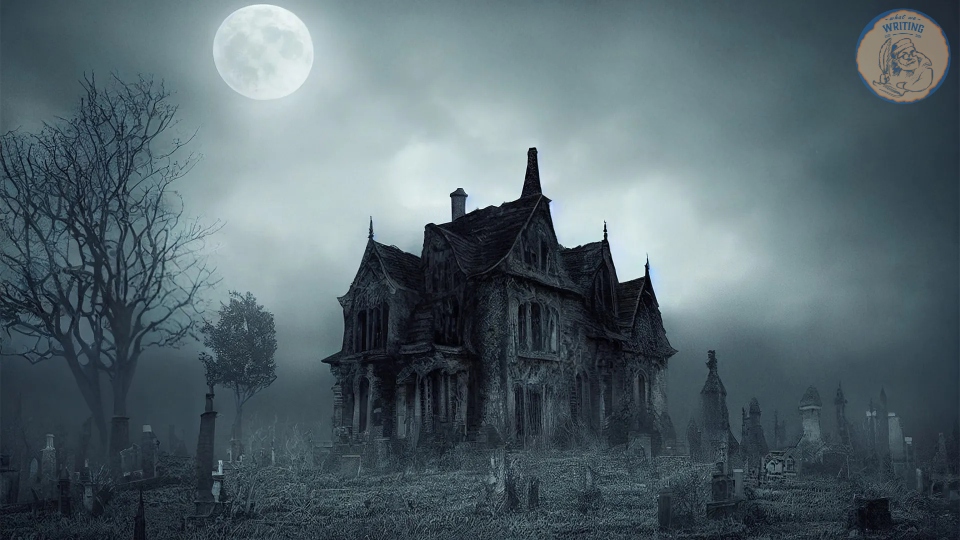
The front door hangs slightly ajar. Not wide enough to welcome you inside – just enough to indicate someone forgot to close it. The air inside is musty and reeks of damp wood; something is sealed behind the walls. The windows are opaque, but not empty. It’s less of a building, more like a closed breath.
When readers look for haunted house descriptions, they’re typically looking for more than dusty hallways and creaking floorboards. They want atmosphere – that delicious rising dread that morphs an otherwise ordinary space into something more sinister. Haunted houses are still one of the most enduring symbols of horror because they twist something familiar into something terrifying. A house should be safe. When it isn’t, the fear turns personal.
Today at What We Writing, you’ll find practical haunted house description examples you can use, along with craft advice on how to structure and pen a truly chilling haunted house story from start to finish.
What Makes A Haunted House So Effective?
The House as a Character
The most memorable haunted house stories work because the house isn’t just a backdrop – it behaves like a character. It has a personality. It possesses a memory. Sometimes, it might even have its own intentions. Walls aren’t just structure; they hold history. Rooms feel welcoming or hostile. Corridors lead the characters somewhere on purpose. When a house starts to influence events rather than being the setting where they occur, the story is upgraded from slightly creepy to really unforgettable.
In Shirley Jackson’sThe Haunting of Hill House, Hill House isn’t just a place where strange things happen – it feels actively involved in them. Its angles are all wrong, its proportions unsettling, and its presence presses in on the characters psychologically. The horror stems not just from what happens inside its walls, but from the fact that the house itself seems aware.
Another example of this is the Overlook Hotel in The Shining. Here, the hotel moulds every part of the narrative. It isolates the Torrance family, amplifies Jack’s instabilities, and appears to feast on vulnerability. The building isn’t passive – it exerts pressure.
That’s the key takeaway: a haunted house story becomes truly compelling when the house wants something. Whether it craves companionship, revenge, control, or simply to be remembered, giving the house desire transforms it from scenery into a force.

How To Write Vivid Haunted House Descriptions
If you’re on the hunt for ways to improve your haunted house descriptions, the key thing to remember is this: don’t just describe what the house looks like. Describe how it feels to exist inside it. Readers shouldn’t just see the house – they should sense it closing in around them.
Let’s break that down.
A. Focus on Atmosphere Rather Than Decoration
One of the most common mistakes we see from writers is when they treat a haunted house almost like a real estate listing. We’re not looking for a full description of each piece of furniture. What we do need is mood.
Rather than giving us a full inventory of objects, focus on:
- Temperature – Is it unnaturally cold? Stifling? Does it change from room to room?
- Smells – Damp wood, extinguished candles, mildew, something metallic or fairly sweet
- Sound – Pipes that rattle at random times, footsteps that might be settling the beams
- Air pressure – Does the space feel heavy? Hard to breathe in?
- Light quality – Thin, grey light. Yellowed bulbs. Corners where light struggles to reach
Compare the difference:
Bad:
“The hallway was dusty and old.”
Better:
“The hallway stunk of damp plaster, as if the walls themselves were sweating.”
The second version invites the reader into a physical experience. It implies neglect and something almost biological about the building itself. This is where you layer in the dread – when the house feels less built, and more organic.
When writing haunted house descriptions, ask yourself: What would standing here do to someone’s body? If you’re able to answer that, your atmosphere will feel alive.
B. Use Sensory Layering
Atmosphere becomes immersive when you’re able to layer in sensory details, as opposed to depending on one obviously creepy element.
A simple technique to use here: add one unexpected sensory detail per paragraph.
For example:
- A staircase that smells faintly of burnt sugar
- Wallpaper that feels oddly soft, almost warm, to the touch
- A room that is inexplicably quieter than it should be – as though sound itself avoids it
Use silence deliberately. Silence is rarely ever empty in horror. It hums. It stretches. It makes the characters aware of their own breathing. A sudden noise is great for jolts; it is in the prolonged quiet that conjures dread.
Allow ordinary things feel slightly wrong. A door that closes too gently. A clock that ticks, but out of rhythm. Curtains that move when the windows are shut. The key here is restraint. Subtle unease is much more disturbing than immediate gore or a big spectacle.
Readers lean forward when they can tell that something is off, but they don’t know what yet.
C. Give the History History
The most effective haunted house descriptions are grounded in a story. A house without a past is just an empty building. A house with history becomes layered with meaning.
Readers are pulled toward:
- Tragedy
- Disappearances
- Buried secrets
- Generational trauma
In Mexican Gothic by Silvia Moreno-Garcia, High Place is inseparable from the corruption and decay of the family within its walls. The rot inside mirrors the moral and physical rot of its lineage. The house doesn’t just contain the past – it preserves it.
When you lend your haunted house a backstory, allow that history to seep into your descriptions.
Rather than stating, “A murder happened here,” show us:
- Stains in the floorboards that no amount of cleaning can fully erase
- A room that stays locked, though no one admits why
- Portraits lining the staircase, one face scratched away
Backstory needs to feel embedded, not explained. The house can remember, even if the characters themselves don’t quite understand what it is remembering.
Ultimately, vivid haunted house descriptions come from blending atmosphere, sensory details, and buried histories. When you upgrade from decorating the space to haunting it with implication, the house morphs into something more than a setting – it becomes a presence.
Types Of Haunted Houses (For Story Variety)
Not every haunted house aims for the same type of fear. If you’re looking for your haunted house descriptions to feel fresh, it helps to decide what kind of haunting you’re handling. Is the threat psychological? Supernatural? Emotional? The answer here will play a pivotal role in shaping the atmosphere, pacing, and even the language you use.
Here are the different types of haunted house stories to keep in mind.
1. The Psychological Haunted House
Easily our favourite type of haunted house story, this version revolves around the question: Is this house really haunted – or is the protagonist unravelling?
The tension here stems from ambiguity. Strange events might have reasonable, rational explanations. Shadows might be trickles of light. Noises could be the settling of old pipes. However, as the protagonist’s mental state deteriorates, the house appears to close in.
In The Turn of the Screw, the governess’s perspective shapes everything we see. The estate feels oppressive and watchful, but we’re never given definitive proof that there’s anything supernatural at work. The horror comes from that uncertainty.
When writing this type of haunted house, your descriptions should lean into doubt:
- Glimpses rather than clear sightings
- Sounds that stop when investigated
- Mirrors, reflections, and warped perceptions
The house becomes a projection of the character’s instability. Its corridors mirror their spiralling thoughts.
2. The Malevolent Entity House
Here, the house isn’t something misunderstood. It’s actively hostile.
Doors slam without any drafts. Objects move around with intention. The building cuts off its inhabitants, rendering help or escape impossible. The house isn’t the home of a ghost – it’s an active hunter.
In The Conjuring, the farmhouse becomes a battleground between the living and the unseen. The space itself feels targeted, as if it has chosen its victims.
For this type, your haunted house descriptions need to feel invasive.
- Sudden cold spots that follow characters
- Rooms that appear to rearrange themselves
- Stairs that groan in response to footsteps
Give the house its own agency. Let it react.
3. The Grieving House
Not every haunted house is violent. Sometimes, they’re sorrowful.
In a grieving house, the horror comes from memory, rather than malice. The past hangs in the air. The space is heavily absent.
The Little Stranger depicts a crumbling estate haunted just as much by social decline and repression as it is by anything supernatural. The house reflects the emotional decay of those who are tethered to it.
Descriptions here should empathise:
- Fading grandeur
- Neglected rooms
- Objects preserved long after they’re useful
The house here isn’t attacking. It’s remembering.
Landing on your haunted house type early on will guide each description you write. Is your house warping realities, hunting its inhabitants, or mourning something its lost? Once you know what it wants, your story gains clarity – and your atmosphere heightens.
Structure: How To Write A Haunted House Story
Once you’ve crafted atmospheric haunted house descriptions, you need a strong narrative framework to support them. The best haunted house stories are the ones where tension builds gradually. The fear needs to feel earned – not sudden, but inevitable.
Here’s a handy five-step structure plan you can use to write your own haunted house story.
Step 1: The Invitation
Every haunted house story starts off with a reason to enter.
This “invitation” doesn’t need to be literal, but it does need to feel believable. Common motivations include:
- An unexpected inheritance
- Suspiciously cheap rent
- Academic or paranormal curiosity
- Financial desperation
- An urge to escape
The aim here is emotional vulnerability. Your main character shouldn’t just move into the house – they should have to. That need is precisely what keeps them here even as the warning signs mount up around them.
Step 2: The First Disturbance
Start small.
A haunted house story becomes far more effective when the first unsettling moment is easy to dismiss. This could be:
- A door left ajar
- Sounds that could be dismissed as pipes
- A lost object
- A cold room with no draft
This stage is where a slight wrongness is introduced. Nothing especially supernatural needs to happen. In fact, restraint builds credibility. The audience should start to wonder: Is this a coincidence?
If the character can rationalise things, you’re on the right track.
Step 3: Escalation
This is where the house begins to push back. The disturbances start to become impossible to ignore:
- Physical manifestations
- Objects move with intention
- Nightmares begin to bleed into real life
- Locked rooms start opening
At the same time, isolation increases. Phones lose signal. Neighbours grow distant. Weather traps your characters indoors. The house becomes its own ecosystem.
This is where you can sprinkle in some conflict between your characters. Not everyone is going to believe a haunting is occurring at the same time. Paranoia sets in. Accusations fly. Relationships fracture. The horror intensifies because it’s no longer just external – it’s interpersonal.
Step 4: Revelation
Eventually, something needs to be discovered. This revelation can take two distinct forms:
- The truth about the house (a buried crime, a curse, a lingering presence)
- The truth about the protagonist (guilt, repression, instability, grief)
Often, the most powerful stories blend a bit of both of these. The house’s history mirrors the character’s inner struggle.
This is where everything snaps into place. The strange details layered in earlier gain a deeper meaning.
Step 5: The Ending
Haunted house stories rarely ever end nicely and neatly. Consider the tone you’d like to leave your audience with. Some of the most common endings we’ve seen around:
- Escape – The protagonists survive, but carry psychological scars
- Possession – The house claims them
- Acceptance – The character chooses to remain, forming a strange new coexistence
- The house wins – The cycle starts over again with someone new
Whichever of these endings you land on, it should feel like the natural consequence of the house’s desire. Haunted house books are at their strongest when the final outcome feels less like a sudden twist – and more like fate.
Common Mistakes When Writing Haunted House Descriptions
Even the greatest haunted house horror premise in the world can fall flat if it depends on the usual, overused tropes. If you want your haunted house descriptions to feel fresh and unsettling, watch out for these common mistakes.
Check Out Our Guide To The Best Horror Tropes
Overusing cliches. Creaking floorboards. Icy fingers trailing down spines. Cobwebs hang in every corner. These images aren’t useless – but they’ve been done so often that they hardly ever surprise anymore. Try to identify details that are unique to your house. What makes this building specifically unsettling in a way no other is?
Explaining the haunting too early. Mystery is fuel for dread. If the audience immediately knows who the ghost is, how they died, and what they’re after, the tension deflates. In an example like The Woman in Black, the bulk of the terror comes from what isn’t explained. The sense of something wrong lingers long before clarity arrives.
Making the house scary only at night. Haunted houses can feel eerie any time of day. Morning light can expose decay. Silence at noon can feel just as oppressive as midnight whispers.
Relying on jump scares rather than dread. A slammed door startles. Sustained unease lingers. Aim for tension that tightens slowly rather than spikes and evaporates.
Haunted House Description Writing Exercise
Try this:
Write a 150-word haunted house description where:
- Nothing supernatural occurs
- No ghosts appear
- The house still feels threatening
Focus on the atmosphere and restraint. Use sensory language – temperature, sound, light, smell. Allow ordinary features feel slightly misplaced or too neatly arranged. Avoid any dramatic language. Instead, suggest that something isn’t right without ever drawing attention to it directly.
If the reader finishes your paragraph feeling watched – even though nothing’s actually happened – you’ve done your job and captured precisely what makes haunted house stories so chillingly addictive.
Wrap Up
Haunted house stories are still one of the most popular subgenres in the horror world because they morph something familiar into something profoundly unsettling. A house should protect us. When it watches, remembers, or wants something in return, that safety fractures. The most powerful haunted house descriptions don’t depend on cheap scares or overused cliches – they build atmosphere slowly, layer sensory detail, and allow history to seep in through the walls.
Whether your haunted house is psychological, predatory, or quietly grieving, the key here is intention. Choose what your house wants. Once you understand that, each creaking stair, dimly-lit hallway, and locked door becomes infused with meaning – and your story is sure to linger long after the lights go out.
Check Out This Haunted House Quiz Over On Our Sister Site, What We Reading

James has been passionate about storytelling ever since he could hold a pen. Inspired by the epic fantasy and historical dramas he devoured in his youth, his work now centers on dark, psychological tales featuring intense, introspective characters and atmospheric, gothic undertones. In 2025, he founded What We Writing to share his creative journey and the lessons he’s learned along the way with fellow writers and passionate storytellers.

