
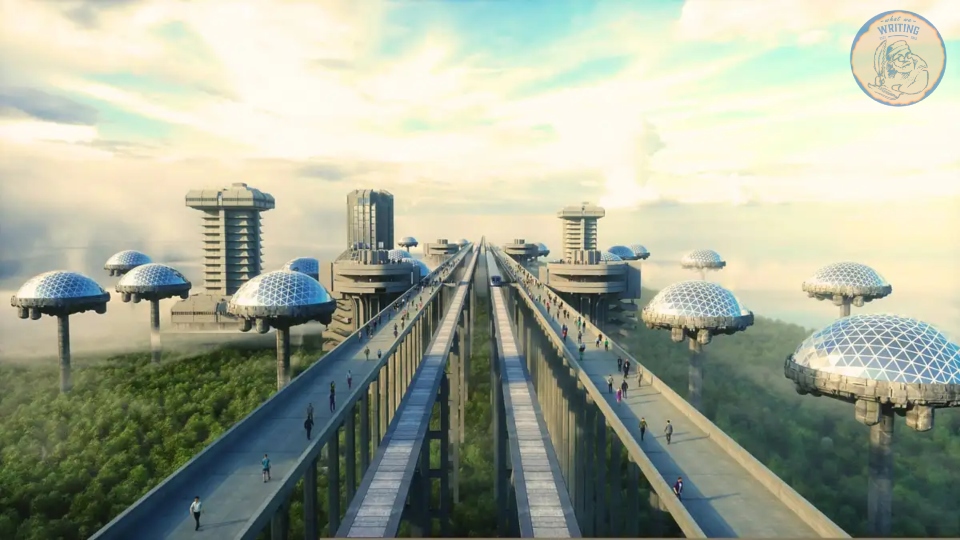
Near-future science fiction is an exciting part of the sci-fi universe that revels in the space between what we know and what might be just around the corner. It specialises in creating worlds just a handful of steps ahead of our – governed by new technologies, shifting social norms, and small changes that could conceivably happen in our own lifetimes. If you’re like us, that closeness is precisely what makes near-future stories so compelling.
Learning how to write near-future sci-fi isn’t just about inventing smart new gadgets or conjuring dramatic dystopias. It’s about crafting a world that feels believable. The best realistic sci-fi writing makes the audience think, Wait, this really could happen. When your environment, technologies, and characters all feel rooted in something real, your story becomes more immersive, more emotional, and far more impactful. Flying cars and holograms are fun, no doubt; however, without social systems, human consequences and emotional depth, they soon feel empty and artificial.
Today at What We Writing, we’re sharing how to write near-future sci-fi that feels real, from researching the latest trends on the horizon to building believable worlds and characters. Whether you’re making your first foray or looking to strengthen your speculative fiction skills, these are the writing tips you need to help create believable stories that truly resonate with readers.
What Is Near-Future Science Fiction?
Near-future sci-fi focuses on worlds that resemble our own, typically set within the next five to fifty years into the future. Rather than imagining distant galaxies or old civilisations far, far away, near-future stories explore how our technologies, politics, and social trends today morph in the coming years.
In near-future fiction writing, the aim is plausibility. The future needs to feel like a natural extension of the present, formed from recognisable patterns, familiar systems, and realistic human behaviour. Your audience needs to be able to look at the story’s world and think, I can see how we got here.
It’s worth sparing a couple of lines to explain how near-future differs from other forms of speculative fiction:
- Near-future sci-fi takes place within a handful of decades and emphasises emerging technologies and social change.
- Distant-future sci-fi is set hundreds or thousands of years into the future, usually involving space travel, alien species, or radically altered societies.
- Contemporary speculative fiction takes place in the present day, with just a couple of changed elements, like a hidden technology or subtle supernatural twists.
Some of the best examples of near-future science fiction include the likes of Black Mirror, Her, The Circle by Dave Eggers, and Station Eleven by Emily St. John Mandel. These works all feel powerful because their settings all feel unnervingly plausible – we can all imagine living in their worlds.
Understanding where your story sits on this spectrum is the first step toward writing near-future science fiction that feels grounded, relevant, and real.

Check Out Our Guide To Writing Speculative Fiction
Start With Today’s World (Then Push It Forward)
Let’s get stuck into how you can write your very own Black Mirror universe.
Strong writing near-future science fiction begins with a clear understanding of the present. Before you can go about changing things, you need to know what already exists. Today’s technology, political tensions, cultural trends, and social issues form the groundwork for tomorrow’s world.
Pay close attention to the ways in which we interact with elements like AI, social media, surveillance tools, renewable energy, and digital platforms. Take note of how governments respond to crises, how public opinion shifts online, and how communities adapt to big upheavals. These real-world patterns lend your story authenticity.
One of the most useful speculative fiction writing tips is learning how to extrapolate. Extrapolation is all about taking something that’s already present and asking, What would happen if this continued, accelerated, or spread? A small innovation, policy change, or cultural shift can totally upend society in unexpected ways over time.
An example of this could be something along the lines of a small update to facial recognition software, leading to widespread monitoring. A productivity app might become a tool for corporate control. A leaning toward remote working might completely transform cities and family life. In this genre, it is often the smallest changes that lead to the biggest consequences.
By rooting your story in today’s reality and subtly driving it forward, you can create a future that feels connected and believable, rather than something random or convenient.
Research Emerging Trends And Technologies
If you’re looking to write realistic sci-fi that sells, research is a non-negotiable. Near-future sci-fi only feels authentic when it adds onto things already happening.
Start off by paying close attention to fast-moving fields such as artificial intelligence, climate technology, digital surveillance, biotechnology, and the ongoing social media revolution. These are all already areas that are reshaping our lives, and they offer material ripe for speculative stories.
As an example, AI tools are changing the way in which we make decisions. Climate tech is driving urban planning and energy infrastructure. Surveillance software is raising questions about identity and control. Biotech is upending health and longevity. Social media is changing the way we influence others. Any one of these trends has the potential to create compelling near-future scenarios.
To support realistic sci-fi worldbuilding, delve beneath the headlines. Useful sources can be found in technology journalism, academic journals, science podcasts, futurist essays, and interviews with researchers. You don’t need to enrol in a PhD, but you should be able to get the basics of the technology you’re leaning on.
At the same time, don’t get cocky, kid. Long explanations and technical jargon that flex your research often just slow your story down. Rather than info-dumping, reveal details naturally through character actions, dialogue, and everyday routines.
When research supports the story rather than dominates it, your future technology feels authentic, accessible, and emotionally grounded.
Build Believable Systems, Not Just Gadgets
In strong near-future fiction, technology doesn’t just exist in isolation. Each new invention reshapes society in subtle and far-reaching ways. That’s why effective sci-fi worldbuilding near-future stories hone in on the systems, rather than impressive devices.
When you introduce a new tool, app, or scientific breakthrough, ask how it affects the everyday. Who controls it? Who benefits from it? Who is excluded? How does it change the way we work, learn, and love? These humble questions can help upgrade simple ideas into believable worlds.
Take something like a health-monitoring implant. Far from being just a medical device, it might influence insurance policies, employment decisions, and social status.
A smart city network isn’t just convenient – it could have serious ramifications for surveillance, inequality, and political control. In writing believable sci-fi, these ripple effects matter far more than the technology itself.
Talking about the institutions that grow around innovation. Laws, corporations, schools, and governments will adapt to new systems, often in unexpected ways. Cultural norms evolve. New etiquette, slang, and social tensions emerge. All of these details help make your new world feel lived-in, rather than staged.
By honing your focus on the ways in which technology reshapes society as a whole, you go beyond surface-level futurism and build a world that feels complex, coherent, and real.
Focus On Human Stories First
No matter how far-flung into the future your story is, readers will always connect more strongly with people, not predictions. The most powerful near-future stories succeed because they place human experience at the core of the narrative. Technology might shape the world, but it’s the people who drive the story.
When working on believable sci-fi, begin by asking what your characters want, fear, and struggle with. How does the future complicate their relationships? What pressures does it place on their identity, career, or sense of self? These are the personal stakes that make speculative worlds feel real.
Orbiting around AI isn’t only about algorithms or predictive behaviour – it’s about people losing their jobs. A story about climate migration isn’t about rising sea levels – it’s about families being forced to leave their homes behind. A story about surveillance isn’t about cameras – it’s about trust, privacy, and paranoia. Rooting grand ideas in individual lives creates that emotional impact you’re looking for.
Strong characters are also a great remedy for a story that feels more like a technical exercise. Rather than explaining how a world works, you can show it in someone’s routines, conflicts, and choices. Your audience learns about the future naturally by watching others navigate it.
When you put human stories first, your near-future setting becomes more than a backdrop. It becomes a meaningful space where real emotions, moral dilemmas, and personal transformations can all unfold.
Check Out Our Guide On How To Write An Alternate History Story
Use Language And Detail To Ground The Future
One of the easiest ways to make a near-future setting feel real is through careful, thoughtful detail. The right language decisions can turn an unfamiliar world into something your audience immediately recognises and understands.
In realistic sci-fi writing, the future is usually at its most convincing when it’s constructed from believable elements. Everyday objects, routines, and environments should still exist – just with a few extra changes. A cafe might use automated ordering. A school could rely on learning implants. A bus stop might display personalised ads. These small touches all quietly signal that the world has moved forward.
Pay attention to sensory details. What does the technology sound like? How does it feel to wear, touch, or rely on? What does a polluted megacity smell like? These physical details all ground your story in a lived-in experience.
You also don’t want to overwhelm your reader with a huge amount of technical jargon. Long explanations and invented terminology can lead to distance rather than immersion. Instead, introduce new concepts gradually and through context. Allow your audience to learn by watching the characters interact with their surroundings.
Dialogue is also a handy tool to use here. Slang, shorthand references, and casual mentions of technology can suggest a fully developed culture without needing lengthy descriptions. When your characters treat technological advancements as something normal, your audience will too.
By using clear, grounded language and carefully chosen details, you make your settings feel obtainable, consistent, and emotionally real – rather than abstract or artificial.
Practical Exercise: Try Writing Your Own Near-Future Scene
One of the best ways of kickstarting your near-future sci-fi writing journey is by getting stuck in with your own small scene. This exercise only takes 15-30 minutes, but it can help you explore how technology, society, and human emotion interact in your imagined future.
Step-by-step prompt:
- Pick a small change from today’s world.
Decide on one technological, cultural, or social trend and imagine how it has evolved 10-20 years from now. - Define the impact on daily life.
How does this one change affect everyone’s daily life? Jobs, communication, privacy, or relationships? Think smaller-scale to begin with – it’s the everyday details that feel real. - Create a short scene.
Write a 200-500-word snippet showing a character interacting with this future world. Focus on their feelings, choices, and reactions rather than explaining the technology. - Add sensory details.
What does the world look, sound, or feel like? How do ordinary objects or routines differ from today?
Optional challenge:
Introduce a subtle conflict or moral dilemma caused by the change. Perhaps a character is uncomfortable with a new AI system, struggles with climate-induced restrictions, or navigates social pressures from new tech.
This exercise is perfect for helping you to practice writing believable sci-fi in a concrete, hands-on way. Over time, repeated practice like this will make building realistic near-future worlds feel natural.
Wrap Up
Writing convincing near-future sci-fi isn’t just about imagining futuristic technology – it’s about imagining a world that feels tethered to today, shaped by believable trends, social systems, and human choices. By grounding your story in the present, researching emergency technology, building systems rather than gadgets, and keeping characters at the centre of your storytelling, anyone can create the next great sci-fi read.
Remember: it’s the small, realistic changes that have the biggest consequences, and subtle details can make your future world feel lived-in and immersive. Use exercises, observe today’s trends, and always ask how your imagined future affects real people.
With practice, you’ll gain the confidence in writing near-future sci-fi that feels both plausible and emotionally engaged.

James has been passionate about storytelling ever since he could hold a pen. Inspired by the epic fantasy and historical dramas he devoured in his youth, his work now centers on dark, psychological tales featuring intense, introspective characters and atmospheric, gothic undertones. In 2025, he founded What We Writing to share his creative journey and the lessons he’s learned along the way with fellow writers and passionate storytellers.

