
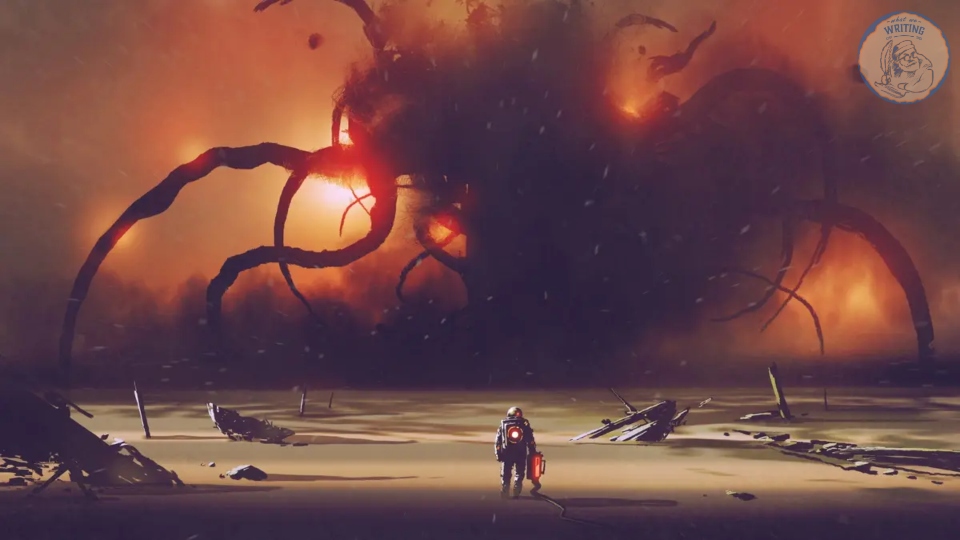
Science fiction has always been one of the most inventive genres in literature. Sci-fi stories whisk readers on adventures across faraway galaxies, fauna-infested worlds, and everywhere in between. We’re introduced to otherworldly characters and new technologies along the way. But what exactly do we mean when we ask: “What is science fiction really?” From its early speculative origins to the modern blockbusters in both print and on screen, in this guide, we here at What We Writing will uncover the origins of the sci-fi genre, some of the most iconic and famous books from across the science fiction space, explore its characteristics and many subgenres, and provide you with some of our favourite writing tips for writing a sci-fi story that feels fresh and unique.
What Is Science Fiction Writing?
Science fiction is a genre of speculative fiction that features imagined elements that don’t exist in the real world. Sci-fi encompasses a broad range of themes that often explore time travel, space exploration, and are set in the future, and grapple with the consequences of technological and scientific developments.
At its heart, science fiction writing is a form of storytelling that explores what could be possible if science and technology were pushed beyond their current limits. Unlike fantasy, which builds entirely invented worlds with their own magic, science fiction remains tethered – loosely or tightly – to scientific principles. Whether it’s interstellar travel, artificial intelligence, or genetic engineering, sci-fi asks: What happens to humanity if this becomes real?

History Of Sci-Fi Literature
Origins
The science fiction genre can trace its roots back as far as the second century. A True Story, penned by a Syrian satirist called Lucian, is often credited as being the first sci-fi story, which explored other universes and extraterrestrial lifeforms.
The Age of Enlightenment ushered in a new era of scientific understanding and developments, which writers such as Francis Bacon, Johannes Kepler and Cyrano de Bergerac reacted to.
Mary Shelley’s Frankenstein is often called the first modern science fiction novel, blending gothic horror with questions around science, creation, and responsibility. Later that century, Jules Verne (Journey to the Centre of the Earth) and H.G. Wells (The War of the Worlds) expanded the genre, using adventure and imagination to explore scientific ideas.
The Golden Age (1930s-1950s)
Often called the “classic era,” this period witnessed the rise of acclaimed writers such as Isaac Asimov, Robert A. Heinlein, and Arthur C. Clarke. The stories emphasised logic, discovery, and futuristic technologies. Landmark works like Foundation, Starship Troopers, and Childhood’s End established the core identity of modern sci-fi.
The New Wave (1960s-1980s)
In contrast to the Golden Age, the New Wave focused less on technology and more on psychology, society, and philosophy. Writers such as Ursula K. Le Guin (The Left Hand of Darkness), Philip K. Dick (Do Androids Dream of Electric Sheep?), and William Gibson (Neuromancer) pushed boundaries by blending literary experimentation with cyberpunk, dystopia, and social commentary.
Contemporary Science Fiction (1990s-)
Today’s sci-fi is more diverse than ever, exploring not only space and technology but also identity, ecology, and power dynamics. Authors such as Octavia E. Butler (Parable of the Sower), N.K. Jemisin (The Broken Earth Trilogy) and Liu Cixin (The Three-Body Problem) highlight how the genre evolves alongside real-world science, politics, and climate concerns.
Throughout its history, science fiction has reflected humanity’s relationship with technology – from the fear of unchecked invention in Frankenstein to the awe of space exploration in 2001: A Space Odyssey to the ethical debates around AI today.
Each era reflects the hopes and anxieties of its time, making science fiction not only entertainment, but also a cultural record of where we’ve been – and where we may be going.
Characteristics Of Science Fiction Writing
Science fiction is often called the “literature of ideas.” Sci-fi novels include a wide variety of futuristic concepts. Since they’re so imaginative, the opportunities really are limitless, particularly in soft science fiction novels. A sci-fi novel can be about space, time travel, evil aliens, or time-travelling to wherenever or whenever.
Regardless of the setting and characters, all science fiction stories are complex, feature nuanced details, and explore wider themes and commentary – sometimes satirically – about society below the surface.
The classic characteristics of a science fiction story include:
- Teleportation
- Time travel
- Superintelligent computers, machines, and robots
- Speculative technologies
- Mind control, telepathy, and telekinesis
- Alternative histories
- Interplanetary conflicts
- Parallel universes and fictional worlds
- Space travel and exploration
- Aliens, extra-terrestrial life, and mutants
What’s The Difference Between Hard Vs. Soft Sci-Fi?
Science fiction is divided into two broad categories: hard sci-fi and soft sci-fi.
- Hard sci-fi novels are grounded in scientific fact. They’re inspired by “hard” natural sciences such as physics, chemistry, and astronomy.
- Soft sci-fi novels can be two things. Either they are not scientifically accurate or they’re inspired by “soft” social sciences such as psychology, anthropology, and sociology.
The terms are flexible, but they help readers quickly understand the foundation of a novel and what to expect from it.
8 Subgenres Of Science Fiction
One of the reasons science fiction is so enduring is its range of subgenres. Writers can approach the future, technology, and human imagination in wildly different ways, from gritty urban landscapes to sweeping space epics. Here are some of the most influential types of sci-fi:
Cyberpunk
Sci-fi stories that blend technology with steam-powered machinery.
- Example: Neuromancer by William Gibson, Snow Crash by Neal Stephenson.
Dystopian Science Fiction
Sci-fi stories about societies the authors deem to be problematic for things like government rules, poverty, or oppression.
- Example: 1984 by George Orwell, The Hunger Games by Suzanne Collins.
Space Opera
A play on the term “soap opera,” sci-fi stories that take place in outer space and orbit around conflict, romance, and adventure.
- Example: Dune by Frank Herbert, The Expanse series by James S.A. Corey.
Military Science Fiction
Focuses on soldiers, strategy, and futuristic warfare – often set against alien or interplanetary backdrops.
- Example: Starship Troopers by Robert A. Heinlein, Old Man’s War by John Scalzi.
Climate Fiction (“Cli-Fi”)
A newer subgenre that explores ecological disasters, climate change, and humanity’s struggle to survive in a transformed world.
- Example: The Water Knife by Paolo Bacigalupi, Parable of the Sower by Octavia E. Butler.
Biopunk / Genetic Engineering Science Fiction
Centres around biotechnology, genetic modification, and ethical dilemmas about altering life itself.
- Example: Oryx and Crake by Margaret Atwood, Jurassic Park by Michael Crichton.
Alternate History / Parallel Universes
Reimagines history with a twist – what if events had turned out differently, or other realities existed alongside ours?
- Example: The Man in the High Castle by Philip K. Dick, Dark Matter by Blake Crouch.
Check Out Our Guide To The Alternate History Genre
AI & Robotics Fiction
Explores artificial intelligence, machine consciousness, and the relationship between humans and their creations.
- Example: I, Robot by Isaac Asimov, Klara and the Sun by Kazuo Ishiguro.
Summary of Science Fiction Subgenres
| Subgenre | Core Focus | Example Books |
| Cyberpunk | High-tech futures, hackers, corporate control, virtual realities | Neuromancer by William Gibson; Snow Crash by Neal Stephenson |
| Dystopian | Oppressive societies, surveillance, climate or political collapse | 1984 by George Orwell; The Hunger Games by Suzanne Collins |
| Space Opera | Epic interstellar adventures, wars, and political intrigue | Dune by Frank Herbert; The Expanse by James S.A. Corey |
| Military Sci-Fi | Futuristic warfare, soldiers, alien conflict | Starship Troopers by Robert A. Heinlein; Old Man’s War by John Scalzi |
| Climate Fiction (Cli-Fi) | Climate change, ecological disasters, survival | Parable of the Sower by Octavia E. Butler; The Water Knife by Paolo Bacigalupi |
| Biopunk / Genetic Sci-Fi | Biotechnology, genetic modification, ethics of science | Oryx and Crake by Margaret Atwood; Jurassic Park by Michael Crichton |
| Alternate History / Parallel Universes | “What if” scenarios, alternate timelines, multiverse | The Man in the High Castle by Philip K. Dick; Dark Matter by Blake Crouch |
| AI & Robotics | Artificial intelligence, machine consciousness, human-robot relations | I, Robot by Isaac Asimov; Klara and the Sun by Kazuo Ishiguro |
Tips For Writing Science Fiction
Take Inspiration From Real-Life
Take an idea from current society and move it a little further down the road. Even if human beings are short-term thinkers, fiction can anticipate and extrapolate into multiple versions of the future.
Do Your Research
It might seem a little paradoxical, but research will undoubtedly strengthen your work, no matter how far you end up wandering from historical facts. Conducting research too early in the drafting process can sidetrack or slow down the plot; however, it’s important to keep your reader immersed in and believing the authenticity of the world you’ve built.
Check Out Our Guide On How To Write Realistic Sci-Fi Worlds
Getting the details wrong can throw off their belief in your story.
Create Rules (And Stick With Them Throughout)
Sci-fi isn’t automatically interesting; it needs to be compelling, plausible, and accurate within its own set of rules. Rules add weight to the material or change the stakes for both your characters and audience.
Once you establish a rule, if you break it, you break the illusion of a believable and compelling world.
Keep it Rooted in Reality
Any technological or even fantastical element in sci-fi needs to have roots in what our current species can already do or is on the road to being able to do one day.
Wrap Up
At its core, science fiction writing is the art of asking “what if?” and following that question into the unknown. Defined by its connection to science and technology, the genre thrives on futuristic settings, imaginative speculation, and deep explorations of how humanity might adapt – or fail to adapt – to new realities. Whether through space travel, artificial intelligence, or climate collapse, science fiction always circles back to the same core principle: what it means to be human in the face of change.
For aspiring writers, the best way to learn science fiction is to experiment with it yourself. Try building a short story around a single “what if” scenario. What if robots outlived us? What if Earth became uninhabitable? What if we found a way to spark parallel versions of ourselves? Small thought experiments can grow into powerful stories.
If you’re looking for inspiration, start with a classic such as Dune by Frank Herbert, or a modern hit like Project Hail Mary by Andy Weir. And then – don’t just read. Write. Sci-fi has always been about pushing boundaries, and the next groundbreaking idea could be yours.

James has been passionate about storytelling ever since he could hold a pen. Inspired by the epic fantasy and historical dramas he devoured in his youth, his work now centers on dark, psychological tales featuring intense, introspective characters and atmospheric, gothic undertones. In 2025, he founded What We Writing to share his creative journey and the lessons he’s learned along the way with fellow writers and passionate storytellers.

