
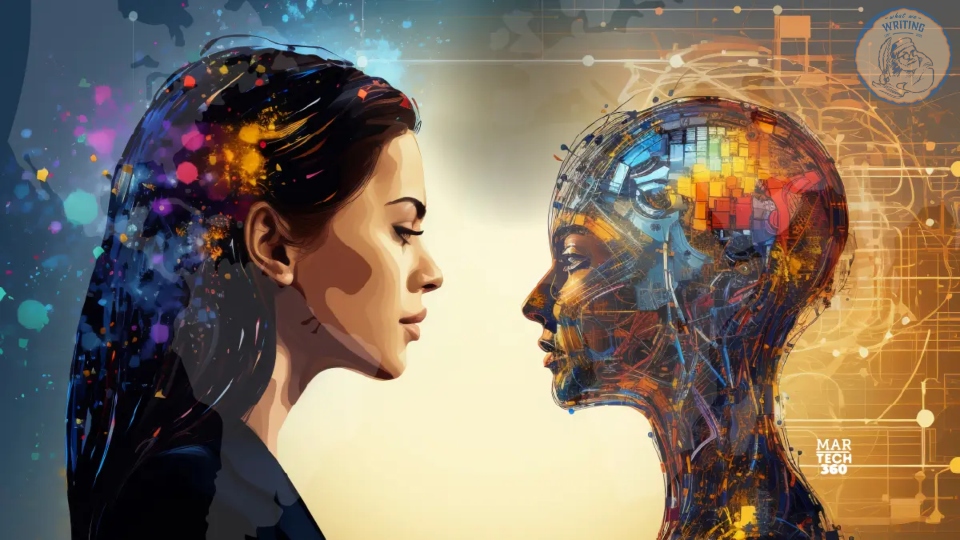
Artificial intelligence now comes with the ability to conjure stories, generate artwork, compose music, and even help brainstorm ideas. With AI tools only becoming more complex, it’s easy to see why so many people claim we’ve entered a new age of creativity. If machines can produce paintings, poems, and novels, doesn’t that mean it’s creative?
The debate around AI and creativity has become one of the fiercest questions of the digital age. Whilst AI can undoubtedly do some impressive things for us writers, we can’t be the only ones arguing that creativity involves far more than just producing something new. Creativity has always been about emotion, personal experiences, intention, and the desire to evoke meaning – qualities that machines can’t, and probably will never be able to, replicate.
So, can AI be creative? Today at What We Writing, we’ll explore how AI generates creative work, examine the key differences in the AI vs human creativity debate, and take a closer look at what AI gets wrong about the creative process itself.
Can AI Be Creative?
Before we begin delving into the question of whether AI can be creative, it’s worth sparing a few lines meditating on what creativity actually means. According to Merriam-Webster, creativity is “the process of being creative.” Helpful, eh?
Most definitions describe creativity as the ability to produce something original and valuable. Creativity often involves combining existing ideas in new ways, solving problems from unexpected angles, or expressing thoughts and emotions through art, music, writing, and other forms of creation.
Through that definition, artificial intelligence creativity can appear surprisingly impressive. Modern AI systems can generate paintings in a wide array of artistic styles, compose original pieces of music, pen stories and poems, and even help brainstorm new ideas. By analysing vast amounts of existing data, AI can identify patterns and blend elements in ways that produce outputs that can feel fresh.
This ability to generate novel combinations is one of the arguments that those in favour of AI creativity put forward. A chatbot can write a fantasy story in the style of a classic author, while an image generator can blend artistic influences to create something that has never existed before. The end result can be impressive enough to make it seem like AI is engaging in a similar creative process as a human artist.
However, this is where the debate becomes a tad more complex.
Whilst AI can imitate the products of creativity, it’s less obvious whether it actually participates in creativity itself. Producing a creative-looking result isn’t necessarily the same as experiencing inspiration, making meaning, or expressing a unique perspective. To understand why, we need to explore how AI generates its work in the first place.

How AI Creates Art, Writing, And Ideas
If we want to understand the debate around AI and creativity, we need to know what AI is actually doing when it ‘creates’ art, stories, music, or ideas. Despite how impressive the results can be, generative AI does not create in the same way we humans do.
At its core, AI depends on pattern recognition. It is trained on enormous amounts of existing data, which may include books, articles, paintings, photos, songs, and other creative works. By analysing these examples, AI learns relationships between words, images, sounds, and concepts. When you give it a prompt, it uses those patterns to predict what should come next and generates a response.
This is why AI-generated writing can feel coherent, and why AI-generated art can be exceptionally convincing. The system has learned from countless examples and can recombine elements in ways that feel original.
Why AI Appears Creative
Part of what makes AI seem creative is its ability to produce outputs that have never existed before. It can mix genres, combine artistic influences, and generate unexpected ideas in seconds. An AI may create an epic space opera inspired by different authors or produce an image that blends different artistic styles.
Because these creations are often novel and sometimes even surprising, they resemble the results of human creation. From an outside perspective, the distinctions aren’t always obvious.
Why Creativity Is More Than Pattern Recognition
However, creativity is much more than just combining existing material. Human creators draw on emotions, memories, experiences, beliefs, and personal goals. A novelist may write a story about grief after experiencing loss, while an artist may use their work to explore identity or challenge the status quo.
AI does not possess experiences, emotions, or intentions. It identifies patterns and predicts outputs, but it doesn’t understand the meaning behind what it produces. This distinction lies at the heart of the debate over whether generating creative work is the same as being creative.
What AI Gets Wrong About Creativity
Probably the biggest misconception we see around the human creativity vs AI debate is the assumption that creativity is solely about producing something new.
If that were the case, then a machine capable of generating original images, stories, or songs could fairly be described as a creative.
But, for most of us human creators, creativity is about much more than just the final, finished output. It is about the process, the intention behind the work, and the meaning that lends it its value.
Creativity Isn’t Just Producing Something New
Novelty is definitely a part of creativity, but originality alone isn’t enough. A random assortment of words or shapes may technically be unique, but most people would hesitate to call it creative.
Human creators normally set out with a purpose. A writer might want to tell a story that explores a particular theme. A musician might be trying to express a feeling. A painter might hope to evoke an idea or garner a reaction. The creative process is usually guided by intentions that mould every choice along the way.
On the flip side, AI doesn’t have any aims or desires of its own. It can generate content based on prompts and patterns, but it isn’t trying to communicate something it actually believes or feels. While the product might appear creative, the underlying process lacks the intentionality that many people regard as central to creativity.
Creativity Stems From Personal Experience
One of our favourite arguments for what makes human creativity unique is how connected it is to lived experience.
Many of the most beloved creative works emerged from moments that deeply affected the creator. A novelist might channel personal grief into a story about loss and healing. A poet might write about love, heartache, or longing. Artists have long responded to major historical events, using their work to chronicle experiences, challenge injustices, or make sense of an evolving world.
These works resonate with audiences because they are grounded in genuine human experiences. Even in fictional works, the events are often shaped by real emotions and observations that the creator brings to the page.
AI doesn’t experience grief, love, fear, hope, or joy. It can generate convincing descriptions of these emotions because it has encountered countless examples in its training data, but it has never actually felt them.
As a result, AI knows how to imitate the language and appearance of creative expression, but cannot share the experiences that often inspire it.
Creativity Involves Meaning-Making
Creativity isn’t just about creating objects, stories, or images. It’s also about making meaning.
Humans constantly use creative work to explore questions about themselves and the world around them. Novels examine morality, identity, and relationships. Songs capture emotions that are tricky to express in everyday conversations. Paintings and films reflect cultural values, political tensions, or personal struggles.
When people engage in creative work, they are often looking for understanding, just as much as they are looking for something tangible. The act of creation becomes a way of processing experiences and communicating ideas.
AI does not engage in this sort of meaning-making. It can generate themes, symbols, and narratives because it has learned patterns from works that already exist, but it is not looking to understand or interpret the world.
The meaning stems from the humans who create, use, and respond to the output – not from the AI itself.
Creativity Thrives On Constraints, Emotions, And Contradictions
Human creativity is also led by limitations and contradictions. In a lot of cases, creative breakthroughs happen because people are forced to work within constraints.
Writers face deadlines, wrestle with self-doubt, and face personal challenges. Artists work within the limits of their materials, skills, and circumstances. Musicians often transform difficult emotions into powerful works of art. These constraints do not hinder creativity; they frequently fuel it.
People are also full of contradictions. We can feel both hopeful and afraid of something. We can love someone and be unimaginably frustrated by them. We can hold conflicting beliefs and grapple with uncertainty. These tensions often become the frameworks for compelling stories, music, and art.
AI does not navigate the world through lived experiences. It doesn’t struggle with uncertainty, confront personal challenges, or wrestle with any conflicting emotions.
Again, it’s able to replicate the results of these experiences, but it can’t participate in them. That difference might be ultimately what separates generating creative content from being genuinely creative.
Check Out Our Guide On Overcoming Feeling Cringe As A Writer
AI Vs Human Creativity: The Biggest Differences
The debate around AI vs human creativity often becomes confusing because both humans and AI can produce outputs that appear creative. An AI can generate a painting, write a poem, or compose a piece of music in a matter of seconds. However, the similarities come to an at the end product.
The key distinctions stem from how creative work is produced and what drives the process behind it. While AI excels at identifying patterns and recombining existing information, human creativity is shaped by experience, intention, emotion, and the search for meaning.
| Human Creativity | AI Creativity |
| Fuelled by personal experiences and observations | Sourced through training data and learned patterns |
| Has intentions, goals, and motivations | Responds to prompts and objectives set by users |
| Creates and interprets meaning | Generates outputs based on statistical relationships |
| Influenced by emotions and lived experiences | Does not experience consciousness or emotions |
| Learns through life, relationships, and society | Learns through huge datasets |
| Can challenge, question, and reinterpret ideas | Recombines existing information in new ways |
These differences demonstrate precisely why the AI vs human creativity debate has become so murky. If creativity is defined purely as producing something novel, then AI can appear creative. However, if creativity also involves personal expression, emotional experience, and meaning-making, then human creativity remains fundamentally different.
Ultimately, human creators bring something unique to the creative party: a lifetime of experiences, emotions, beliefs, and perspectives that mould not only what is created, but why it’s been created to begin with.
Why Human Creativity Matters More Than Ever
The rise of AI has understandably led to some pretty serious concerns about where the future of creative work lies, but it has also demonstrated precisely why human creativity is so valuable. In a world increasingly saturated with generated content, originality, perspective, and emotional authenticity should become more treasured, not less.
Storytelling, for example, is about much more than just arranging words into a coherent narrative. The stories that linger with us often mirror human experiences, fears, hopes, and questions about the world. They unveil something about the person who created them, and invite us readers to view life through a different lens.
Human imagination also drives cultural change. Throughout history, artists, writers, musicians, and filmmakers have all challenged social conventions, inspired new movements, and helped societies make sense of major events. Creative thinking allows people to imagine possibilities that do not yet exist and to push beyond accepted protocol.
Most crucially, human creators take risks. They experiment with new forms, explore uncomfortable realities, and create works that may fail as often as they succeed. These risks are typically what lead to the most memorable influential works of art.
AI is now able to assist in the creative process in remarkable ways, but the curiosity, emotion, and lived experience that fuel human creativity remain uniquely our own. Those qualities are what lend creative work its lasting power and significance.
Check Out These Free Writing Tools Every Author Needs

James has been passionate about storytelling ever since he could hold a pen. Inspired by the epic fantasy and historical dramas he devoured in his youth, his work now centers on dark, psychological tales featuring intense, introspective characters and atmospheric, gothic undertones. In 2025, he founded What We Writing to share his creative journey and the lessons he’s learned along the way with fellow writers and passionate storytellers.

