
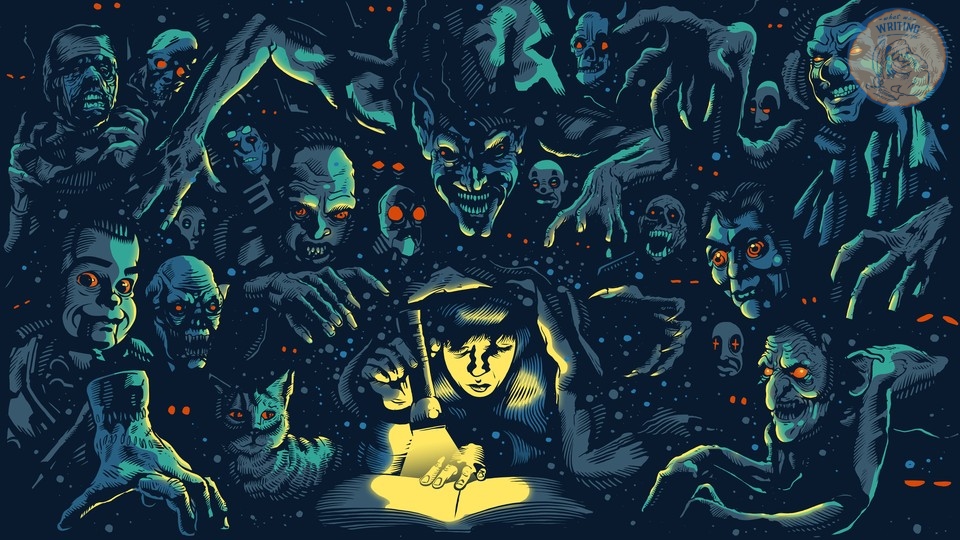
Literary horror isn’t just horror written in beautiful prose. Good sentences alone don’t make a story literary, just as gore and jump scares don’t immediately make a story scary. The difference often comes from what sits beneath the fear.
Horror wants to frighten you. Literary horror wants to frighten you and leave you contemplating why you were scared in the first place.
So, what is literary horror? Literary horror is horror fiction that uses fear, unease, or the uncanny to explore deeper ideas about characters, society, identity, mortality, relationships, or the human condition. It often places character, theme, atmosphere, ambiguity and psychological depth alongside the horror itself, sometimes using existential or philosophical questions to make that fear linger.
Today at What We Writing, we’re exploring how to write literary horror that is unsettling on the surface – and meaningful underneath.
What Is Literary Horror?
Literary horror isn’t necessarily a separate genre with its own list of strict rules. Rather, it’s better understood as an approach to horror – one that employs fear, unease, and the uncanny to explore something deeper.
A literary horror story may be about a monster, a haunting, or a supernatural event, but the horror typically serves a larger purpose. Strong characterisation, psychological depth, and complex themes are often just as important as the frightening elements. Distinctive prose, symbolism, subtext, and ambiguity can also be used to evoke an experience that stays long after the final page is closed.
Rather than leaning solely on cheap scares, literary horror often builds atmosphere and dread, asking moral, philosophical, or existential questions along the way. What does death mean? How far would someone go to escape their guilt? Can we trust our own perceptions? What happens when the thing we fear reveals something uncomfortable about ourselves?
What Makes Horror “Literary”?
There isn’t a checklist that each literary horror story needs to follow. However, it often blends character, theme, atmosphere, psychological complexity and distinctive writing with its central horror.
Symbolism and subtext may give frightening events a second meaning, while ambiguity allows readers to interpret what they’ve experienced themselves.
Is Literary Horror the Same as Psychological Horror?
Sort of, but not quite. Psychological horror focuses mainly on the mind – paranoia, trauma, obsession, unreliable perception and the fear of losing control.
Literary horror can certainly be psychological, but it also has a wider scope. It can use psychological horror alongside symbolism, philosophical questions, thematic depth, and literary style to unearth what the horror ultimately means.

1. Start With What Your Horror Means
Before choosing what monster to create or what supernatural event will terrify your MC, consider a more important question: what am I actually trying to say?
Literary horror is at its best when the frightening elements are tethered to a deeper idea. Your story may explore grief, loneliness, addiction, death, faith, identity, guilt, ageing, isolation, or meaninglessness. It may even explore larger social or philosophical questions surrounding capitalism, religion, or gender.
The horror can then externalise that theme, turning an abstract fear into something the audience is able to experience.
For example, a story about grief doesn’t necessarily need a traditional ghost. Instead, imagine a character who slowly becomes convinced that the person they’ve lost is still communicating with them. At first, that connection may feel comforting. But as the messages become increasingly more disturbing, the character is forced to reckon with whether they’re communicating with the dead – or simply refusing to let them be.
Now the supernatural element isn’t just there to frighten the audience. It’s doing thematic work.
That’s the key distinction. In literary horror, the horror shouldn’t feel like something you’ve just dumped into your story. It should feel tied to the character, their fears, and the larger questions your story is asking.
2. Build the Horror Around A Compelling Character
Literary horror becomes way more effective when we’re scared for the character, rather than just being scared of the monster. The reader needs to care about what happens to them before you can make their suffering genuinely unsettling.
Give your protagonist something beneath the surface: a costly flaw, an unfulfilled desire, a secret they’re desperate to hide, an emotional wound, an obsession or a fear they can’t escape. Contradictions can be especially useful. A character may desperately want connection while pushing everyone else away, for example.
Give Your Character Something to Lose
Horror becomes more powerful when something meaningful is at stake. That might be a relationship, their job, their identity, their mental health, or their sense of reality. The greater the emotional investment, the scarier it becomes when that thing begins to slip away.
Make the Character Part of the Horror
Your protagonist shouldn’t just stumble into something horrifying. Their decisions, desires, memories, beliefs or relationships should somehow feed into it.
Maybe their obsession causes them to investigate something they should leave alone. Perhaps their guilt shapes what they see. Or maybe their desperate need for companionship makes them trust the wrong person.
When the character’s own psychology contributes to the horror, escaping it becomes that much harder. The monster isn’t outside them – it has found a way inside.
3. Choose A Horror Concept That Supports Your Theme
Once you know what your story is looking to say, choose a horror concept that reinforces it. The central horror shouldn’t feel arbitrary; ideally, it should make the story’s underlying theme impossible for the character to ignore.
For example:
Theme: Isolation
Horror: A protagonist discovers that nobody remembers they exist
Theme: Guilt
Horror: Someone starts receiving letters from a person they secretly caused harm to
Theme: Identity
Horror: A protagonist steadily discovers evidence that someone else has been living their life
In each case, the horror isn’t just something scary that happens to the protagonist. It directly confronts something they’re already grappling with.
That’s what makes the premise feel purposeful, rather than decorative. The best literary horror concepts don’t just frighten your characters. They interrogate them. The supernatural or horrifying element becomes a way of forcing the protagonist to confront a fear, belief, or truth they would rather swerve.
4. Prioritise Atmosphere Over Jump Scares
A scary story doesn’t always need to surprise the audience. Often, it’s more effective to let them know something is wrong and make them wait for it to get worse.
That’s the difference between shock and dread.
Shock is something suddenly happening: a door slamming, a body appearing, a character being attacked.
Dread is the feeling that something terrible is approaching, even if the audience doesn’t know exactly what it is. Literary horror often leans heavily into this second approach.
You can build atmosphere through your setting, weather, silence, sensory details, repetition, strange behaviour, absence, pacing, and unexplained details. A light left on in an empty room may be more unsettling than a monster suddenly appearing in it.
Make Ordinary Things Feel Wrong
One of the most effective literary horror techniques is making the familiar feel subtly unfamiliar. A supermarket, bedroom, bus journey, family dinner, or workplace can all become frightening when something doesn’t quite fit.
Maybe everyone at the dinner suddenly stops eating at precisely the same moment. Perhaps the bus driver starts taking a route the passengers don’t recognise.
The setting remains ordinary. It’s the small deviation that makes it feel wrong.
5. Learn How To Use Ambiguity
Literary horror doesn’t always need to explain precisely what’s happening. In fact, leaving certain questions unanswered can make a story considerably more unsettling.
Is the supernatural entity actually real? Is the protagonist reliable? Is the monster literal, or does it represent something psychological? What really happened? And, maybe most importantly, what does it all mean?
Ambiguity gives the reader room to wrestle with these questions themselves. Instead of providing a definitive explanation, you can plant clues, contradictions, and possibilities that encourage different interpretations.
But there’s a crucial distinction between ambiguity and confusion.
Your readers don’t need to understand every factual reality in your story, but they do need to get the emotional reality. They should know what scares your MC, what they’ve lost, and why the situation matters, even if they’re not totally sure what caused it.
Think of ambiguity as leaving doors open, rather than removing the walls entirely. Give your reader enough information to form theories, then resist the temptation to confirm each one.
Sometimes, the most frightening answer is the one the reader needs to construct themselves.
6. Make Your Prose Part Of The Horror
In literary horror, the prose shouldn’t just describe something frightening. The writing itself can evoke discomfort, tension, and psychological unease. Your language, rhythm, and point of view can all become a part of the horror.
Sentence Length
Sentence structure can influence how your audience experiences a scene. Short sentences can accelerate panic and create a breathless sense of urgency. Long, winding sentences can create claustrophobia, confusion, or the feeling of a mind beginning to unravel.
Repetition
Repeating a word, phrase, image, or piece of dialogue can immediately become disturbing when its meaning changes throughout the story. Something initially comforting can be sinister just through repetition.
Imagery
Consider giving your story recurring images that tie to its themes. A story about grief may repeatedly return to empty chairs, fading photographs, or untouched possessions. These images can gradually accumulate emotional and unsettling significance.
Point of View
First person can generate intimacy while allowing you to experiment with unreliable narration. Close third person can similarly trap the audience inside a character’s perspective, making it tough to distinguish between what is actually happening and what they believe is happening.
When the reader experiences the horror through the character’s mind, even the prose can become unreliable.
7. Use The Uncanny To Make The Familiar Feel Strange
One of the most effective tools in literary horror is the uncanny: the feeling that something familiar has become subtly strange or wrong.
The horror doesn’t need to be totally unfamiliar. In fact, something that’s almost normal can be far more disturbing. A person behaving slightly differently. A familiar house that seems to have changed. A loved one who looks and sounds precisely as they should, but somehow doesn’t feel like themselves.
You may write about a photograph containing something that wasn’t there before, or a daily routine that starts repeating in exactly the same way, day after day.
The key here is restraint. Don’t instantly explain why something feels wrong. Allow the reader to spot the discrepancy alongside your protagonist and wonder whether it really means anything or not.
This works because familiarity gives us a sense of safety and predictability. When something subtly disrupts that expectation, our brains naturally begin looking for an explanation.
A normal bedroom with something slightly out of place can therefore be more unsettling than an obviously haunted house.
Make the audience recognise the world before you make them question it. Once the familiar becomes unreliable, nowhere feels totally safe.
8. Let Your Horror Reveal Something About Human Nature
The most unsettling horror typically isn’t about what horrible thing might happen. It’s about what a person may be willing to do when that horrible thing happens.
Put your character under pressure and see what emerges. Fear can expose their instinct for self-preservation, their capacity for betrayal, or the depth of an obsession they’ve tried to suppress. It can reveal denial, cruelty, shame, love, or desperation.
Imagine a character who discovers that someone they love is becoming increasingly dangerous. Do they protect them? Abandon them? Lie for them? Or convince themselves that nothing is wrong because accepting the reality would be too painful?
These choices can become more frightening than the supernatural threat itself.
This is especially effective in literary horror because the central question shifts from “Will the character survive?” to “What will surviving turn them into?”
The horror should force your protagonist to make tough decisions, confront uncomfortable truths, and reveal parts of themselves they may prefer to keep hidden.
When that happens, the reader isn’t just watching someone experience something scary. They’re discovering something uncomfortable about human nature – and maybe even about themselves.
9. Don’t Explain Everything
One of the easiest ways to weaken literary horror is to explain it too much. Resist the urge to tell the reader precisely what the monster is, what every symbol means, exactly what happened, or why the ending should be interpreted a certain way.
The same applies to supernatural mythology. You don’t necessarily need several pages explaining where an entity comes from, what rules govern it, and why it behaves the way it does. Mystery can be more frightening than information.
Rather, think:
Show → suggest → allow the reader to interpret.
Give your audience the evidence they need to form a theory, then leave some space between the clues.
That doesn’t necessarily mean withholding information just to be clever. The story still needs to feel coherent and emotionally satisfying.
A handy rule to keep in mind is:
If the reader can work something out from your evidence, you probably don’t need to explain it.
Trusting your reader can make the horror feel much larger than anything you could explicitly describe.
10. End With A Question, Not Just A Twist
A strong horror ending doesn’t necessarily need to shock the reader with a final twist. In literary horror, it can be more effective to leave them with a question they can’t quite shake.
A conventional twist may say:
“Everything you thought was happening was actually X.”
A literary horror ending asks:
“Here’s what happened. But what does it mean?”
That may leave your readers with a disturbing implication, a moral question, an unresolved mystery, or a totally different understanding of the protagonist. Maybe the final reveal exposes something they’ve spent the whole story denying. Perhaps the supernatural horror is resolved, but its consequences raise a more disturbing question about human nature.
This doesn’t mean leaving everything unanswered for the sake of ambiguity. The reader should still feel that the story has reached a meaningful conclusion.
Rather, aim to leave them with something worth thinking about after the story ends.
The best literary horror endings don’t necessarily make the reader gasp.
They make the reader close the book, sit quietly for a moment, and wonder what they’ve just read.
Check Out Our Guide On How To Write Slow Burn Horror
Literary Horror Vs Traditional Horror
Literary horror and traditional horror aren’t opposing categories. In fact, there’s plenty of overlap between them. A literary horror novel can house monsters, gore, jump scares, and conventional horror mechanics, while a commercially successful horror story can also be deeply literary.
The difference is usually one of emphasis. Literary horror typically places greater weight on character, theme, psychological depth, symbolism, and interpretation, whereas more conventional horror might prioritise plot, scares, and external threats.
| Literary Horror | Traditional/Commercial Horror |
| Character-driven | More plot-driven |
| Theme-heavy | Often focused on scares |
| Comfortable with ambiguity | More likely to explain threats |
| Atmosphere and dread | Can prioritise action and shock |
| Psychological depth | External threat often central |
| Symbolism and subtext | More straightforward storytelling |
| Distinctive literary style | Often more direct and accessible |
These are tendencies rather than rules. Literary doesn’t automatically mean better, and traditional doesn’t mean simplistic. A story can be terrifying, commercially accessible, and intellectually rich all at the same time.
When learning how to write literary horror, the aim isn’t to remove the elements that make horror so compelling. It’s to give those elements greater emotional, thematic, or psychological meaning.
A Simple Literary Horror Writing Formula
If you’re not sure where to start, you can build a literary horror story around six interconnected elements:
Character + Wound + Theme + Uncanny Premise + Escalation + Ambiguity
Start with your character: perhaps a lonely man recovering from a recent breakup. Give him a wound: he believes everyone eventually leaves him. From there, establish your theme: isolation.
Now introduce your uncanny premise that explores that theme. He meets a mysterious stranger who starts answering the questions he has. As the story progresses, escalate that horror: the stranger reveals increasingly intimate details about the man’s life.
Finally, introduce ambiguity. Who is this stranger? Is he imagining them? Or is something else at work?
This formula works because every element supports the others. The horror isn’t just happening to the protagonist; it’s tied to who he is and what the story is looking to explain.
The result is horror with a purpose: something frightening on the surface, but psychologically or thematically unsettling underneath.
Literary Horror Writing Checklist
Before you finish your literary horror story, ask yourself:
- Does my protagonist have something meaningful to lose?
- What is my story actually about beneath the horror?
- Does the horror directly tie back to the story’s theme?
- Is my setting contributing to the atmosphere and unease?
- Have I established dread as well as moments of shock?
- Can the reader interpret some elements for themselves?
- Is my prose contributing to the unsettling atmosphere?
- Have I avoided unnecessary explanation and exposition?
- Does the horror reveal something important about my character?
- Will the ending give the reader something to think about?
If you can answer yes to most of these questions, your horror is likely doing a pretty good job at doing more than just scaring. It’s using fear to explore character, theme, psychology, and the human condition – which ultimately gives literary horror its depth.
Wrap Up
The most effective literary horror isn’t frightening because something scary happens.
It’s frightening because that terrible thing means something.
It exposes a character. It forces them to confront something they’ve spent years avoiding. It transforms an ordinary fear into something existential. And, ideally, it leaves the audience wondering whether the monster was ever really the most frightening thing in the story.
This is what makes literary horror linger. The fear doesn’t evaporate when the story ends because the questions underneath are still there.
So don’t worry too much about making your horror “literary.”
Rather, try to make it honest, unsettling, and meaningful.
Give your characters something real to fear. Give that fear a deeper purpose. Then trust your reader to unearth what lies beneath the surface.
Because sometimes the scariest stories aren’t the ones that show us something monstrous.
They’re the ones that show us something true.
Check Out These Horror Writing Prompts Around Childhood Fears

James has been passionate about storytelling ever since he could hold a pen. Inspired by the epic fantasy and historical dramas he devoured in his youth, his work now centers on dark, psychological tales featuring intense, introspective characters and atmospheric, gothic undertones. In 2025, he founded What We Writing to share his creative journey and the lessons he’s learned along the way with fellow writers and passionate storytellers.

